Unexplained Fatigue in Women in Their 40s and What Testing Reveals
Hormonal shifts during perimenopause explain fatigue that sleep alone cannot fix.
Unexplained fatigue in women in their 40s often has a biochemical basis, with shifting hormones affecting sleep, stress responses and energy. Understanding that chain changes what testing is for. A targeted blood panel cannot deliver a simple perimenopause verdict, but interpreted with symptoms and cycle history, it can help distinguish hormonal changes from thyroid disease and show what needs closer attention.
Why fatigue in your 40s is not the same as ordinary tiredness
You are sleeping enough, you are not under unusual stress, and yet the exhaustion persists. When those obvious explanations do not fit, calling the problem overwork leaves the central question unanswered. Time spent asleep does not necessarily mean sleep has been restorative. During perimenopause, changes in estrogen and progesterone can disrupt the systems that make rest replenishing, even before the transition is obvious from your periods.
These hormones do much more than act on the reproductive tract: they also affect neurotransmitters, mitochondrial energy production and the stress-response axis. Their changing levels can therefore produce a compound fatigue. UCLA Health notes that greater sensitivity to the natural pre-period estrogen drop can intensify fatigue and mood symptoms at that point in the cycle. What feels unpredictable may have a hormonal rhythm, placing the timing of exhaustion at the centre of the investigation.
The hormonal chain that produces exhaustion
The chain begins with progesterone, which has a calming effect on the nervous system and supports deep, restorative sleep. As progesterone declines during perimenopause, the structure of sleep can suffer. It can occur without hot flashes, so their absence does not rule out a hormonal contribution to poor sleep. Exhaustion can begin before the symptoms most readily associated with menopause appear.
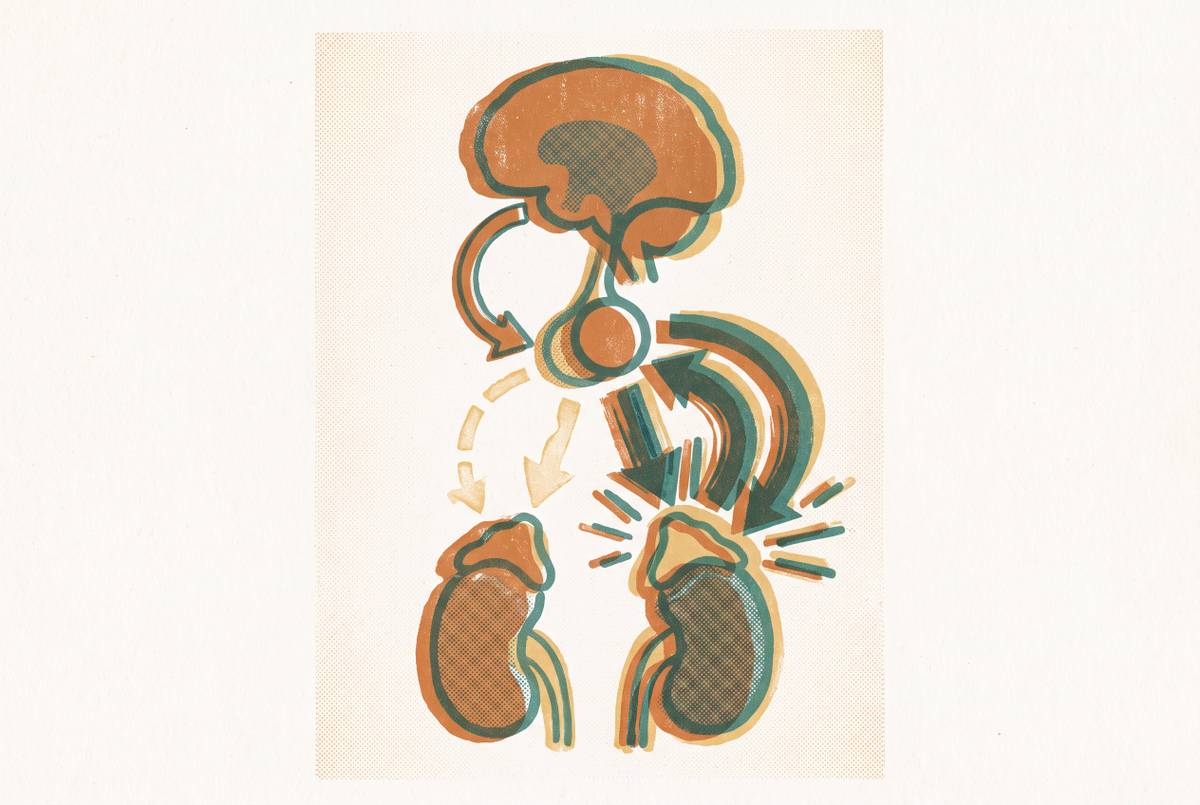
Estrogen adds a second link because it helps regulate the hypothalamic-pituitary-adrenal (HPA) axis, the system governing cortisol release. When estrogen falls, this stress-response system can become more reactive. The resulting cortisol disruption contributes to the “tired but wired” pattern, with exhaustion during the day and difficulty winding down at night. Fragmented sleep then keeps cortisol elevated, making the next night’s sleep worse. Declining progesterone, impaired sleep, a more reactive HPA axis and disrupted cortisol thus form a feedback loop.
That loop helps explain why treating one symptom without seeing how the others fit together may leave other causes at work. It also operates within a broader biochemical picture. Low iron, B12 and magnesium can make fatigue worse, while thyroid dysfunction may develop or worsen in women at the same age. These possibilities make it important to establish which parts of the hormonal and broader biochemical picture apply to the individual woman.
Why the timing of symptoms varies and what the stages explain
Perimenopause averages roughly four years but can extend to ten or more, with earlier starts often associated with longer transitions. It is not a single hormonal state that begins on one date and remains stable. Instead, the balance between progesterone-related sleep disruption and estrogen-related stress-response changes can shift over time. The character of fatigue can change with it.
The STRAW+10 staging framework sets out how women move from the late reproductive stage through early and late perimenopause. Subtle cycle irregularity and early sleep disruption can precede wider cycle swings, while gaps of 60-plus days between periods mark the later transition. In the late reproductive stage, fatigue may be tied to the luteal phase as progesterone fluctuates. In late perimenopause, more dramatic and unpredictable estrogen swings can intensify HPA dysregulation. A symptom that once arrived at a recognisable point in the cycle may consequently become harder to anticipate.
UCLA Health’s Dr. Rajita Patil recommends keeping a symptom journal and tracking symptoms relative to the menstrual cycle. This record can show whether fatigue returns at the same phase or changes as periods become harder to predict. It also supplies context for any blood result taken during that transition. Without that context, a measurement describes the moment more clearly than it describes the process.
How symptoms alone mislead — and why perimenopause is routinely misdiagnosed
Fatigue, poor sleep and mood changes can also occur with anxiety, depression, thyroid disease and other conditions. UCLA Health identifies brain fog, fatigue, anxiety, heart palpitations, joint pain and hair loss as perimenopause symptoms that are commonly missed. These symptoms do not fit the familiar “hot flashes and night sweats” profile. A clinician who looks mainly for that profile may overlook the transition.
Age expectations create another obstacle, particularly for women in their 30s and early 40s who are told they are “too young”. When perimenopause is not considered, overlapping symptoms may be assigned to familiar diagnoses such as depression or generalized anxiety disorder. Behavioral health treatment may then proceed while the hormonal transition remains unaddressed. Yet the alternative is not to explain every psychological symptom away as hormonal. Zhang et al. documented the global burden of anxiety disorders during perimenopause in BMC Women's Health in 2025, reinforcing the importance of considering coexistence.
Diagnostic criteria can also miss an early transition. A Monash University-led study published in The Lancet Diabetes & Endocrinology in 2025 found that women with regular cycles, changed menstrual flow and vasomotor symptoms were classified as premenopausal under standard criteria despite symptom patterns consistent with early perimenopause. The difficulty therefore extends beyond whether an individual clinician recognises fatigue. Testing can help investigate competing explanations, but its value depends on interpreting it within this imperfect clinical picture.
Distinguishing perimenopause fatigue from thyroid disease — and why both can be present
Thyroid dysfunction is an especially important competing explanation because it can produce a nearly identical symptom pattern. Both conditions can cause fatigue, weight changes, sleep disturbance, mood shifts and cognitive difficulty. Hypothyroidism and subclinical hypothyroidism are common during women’s reproductive years and become more prevalent during the late menopause transition and postmenopause. This creates an overlap in both symptoms and timing. Neither a woman’s age nor the intensity of her exhaustion cleanly separates the two.
Perimenopause more often produces drifting, variable cycles, whereas thyroid dysfunction may produce a consistent change in menstrual flow or frequency that persists. Hot flashes and vaginal dryness lean toward the menopausal transition, while cold intolerance, constipation and hoarseness lean toward thyroid dysfunction. The order in which symptoms appeared and the way they cluster also matter.
Most importantly, this is not necessarily a choice between two diagnoses. A woman who recognises a perimenopausal pattern may also have a thyroid abnormality developing at the same time. Finding one does not end the investigation, just as ruling one out does not establish the other. Clinical intuition can identify possibilities, but blood testing helps distinguish thyroid contributions from changes in reproductive hormones.
What a targeted blood panel actually shows — and what it cannot
A targeted panel turns parts of the hormonal picture into measurable data, but each marker answers a different question. Elevated FSH suggests that the pituitary is compensating for declining ovarian output. Estradiol shows how much estrogen is available at the time, so both the result and how it changes across tests matter. Progesterone can help contextualise sleep and mood symptoms, but a low luteal-phase value is interpretable only when the test is timed correctly.
AMH (Anti-Müllerian hormone) reflects ovarian reserve and is less cycle-dependent than FSH or estradiol, making it a more stable signal of ovarian reserve. Thyroid testing examines a different part of the problem through TSH, free T4, free T3 and thyroid antibodies. These results can help show whether the thyroid plays a part that reproductive hormone results cannot explain.
The limits are as important as the measurements. The STRAW+10 framework puts bleeding patterns first and uses hormones as secondary criteria to support them. NICE NG23 recommends two FSH readings four to six weeks apart specifically for women under 40 with suspected premature ovarian insufficiency. That guidance addresses a defined clinical situation, with universal repeat-testing schedules for women in their 40s outside its scope. No single set of values definitively confirms perimenopause, and even a broad panel does not measure every link in the sleep–stress feedback loop. Clinician review is essential to connect the results with symptom history, cycle timing and the question being investigated.
Why one test is a photograph and tracking is the film
The limits of a single panel follow directly from the biology. FSH, estradiol and progesterone fluctuate from cycle to cycle. A value within a reference range on one date can look very different six weeks later. Consequently, an unremarkable result does not necessarily explain away persistent symptoms. One appointment can capture a genuine measurement and still miss the direction of change.
Where repeated testing is clinically appropriate, it allows a different kind of interpretation. Repeated testing can help assess whether estradiol is falling over time, FSH is trending upward or luteal progesterone is consistently lower than before. Those are questions about a trajectory, which no isolated result can answer. The Swiss Perimenopause Study documented changing steroid hormone secretion, including cortisol, through longitudinal observation. Its findings support viewing the transition as a fluctuating process, rather than assuming one measurement describes a fixed state.
Dr. Patil’s recommendation to record symptoms with cycle timing connects what a woman feels with when the change occurs. Timed laboratory results can then be considered against that record. Together, they can help distinguish a transient hormonal dip from a sustained change, affecting the urgency and nature of the clinical conversation. The purpose is not repeated testing for its own sake, but enough well-timed information to answer a question that a snapshot leaves open.
How to use test results to advocate for yourself in a clinical setting
The practical next step is to bring both laboratory results and the symptom log to the clinical conversation. Their combination lets a clinician relate hormonal changes to the functional impact of fatigue and consider whether thyroid dysfunction also contributes. A documented trend gives the discussion something more specific than a general description of exhaustion. FSH that keeps rising across tests, for example, gives a clinician evidence to weigh alongside what they expect at a woman’s age.
If a primary care provider blames fatigue on stress or depression without considering hormones, the Menopause Society’s online directory of certified menopause practitioners offers a way to find a referral. Testing through a service that includes clinician review can also mean arriving with results already organised and interpreted. Neither route replaces a full clinical assessment. Their value is in making the available evidence easier to use and the remaining uncertainty easier to discuss. Dr. Patil’s advice is direct. “Don't suffer silently — recognize what's going on and then advocate for the care you need”.