Adrenal Fatigue Versus HPA Axis Dysregulation
The evidence for HPA dysregulation holds up under scrutiny while adrenal fatigue does not.
“Adrenal fatigue” and HPA axis dysregulation offer different explanations for exhaustion, brain fog, and disturbed sleep. The symptoms deserve investigation, but the distinction is essential. The evidence supports studying how brain-adrenal signaling can become dysregulated, especially during perimenopause, when reproductive hormones complicate both the symptoms and their interpretation.
Why "adrenal fatigue" keeps spreading even though it names the wrong thing
Persistent exhaustion unrelieved by sleep can make ordinary demands feel unmanageable. With difficulty getting out of bed, afternoon crashes, salt and sugar cravings, brain fog, and reduced stress tolerance added to the exhaustion, a named explanation offers something that reassurance does not. It makes the experience feel legible and real. For someone repeatedly told that nothing is wrong, “adrenal fatigue” can therefore feel like recognition. Wellness and supplement marketing spread that explanation widely without showing that the proposed mechanism was how it worked.
The Endocrine Society states that no scientific proof supports adrenal fatigue as a true medical condition and describes its symptoms as common and non-specific. The symptoms alone cannot establish that the adrenal glands are impaired. The evidence summarized across 58 studies found no scientific basis for associating adrenal impairment with fatigue, with most studies finding no difference in salivary cortisol between fatigued and healthy patients.
What the HPA axis actually is and how it breaks down under chronic stress
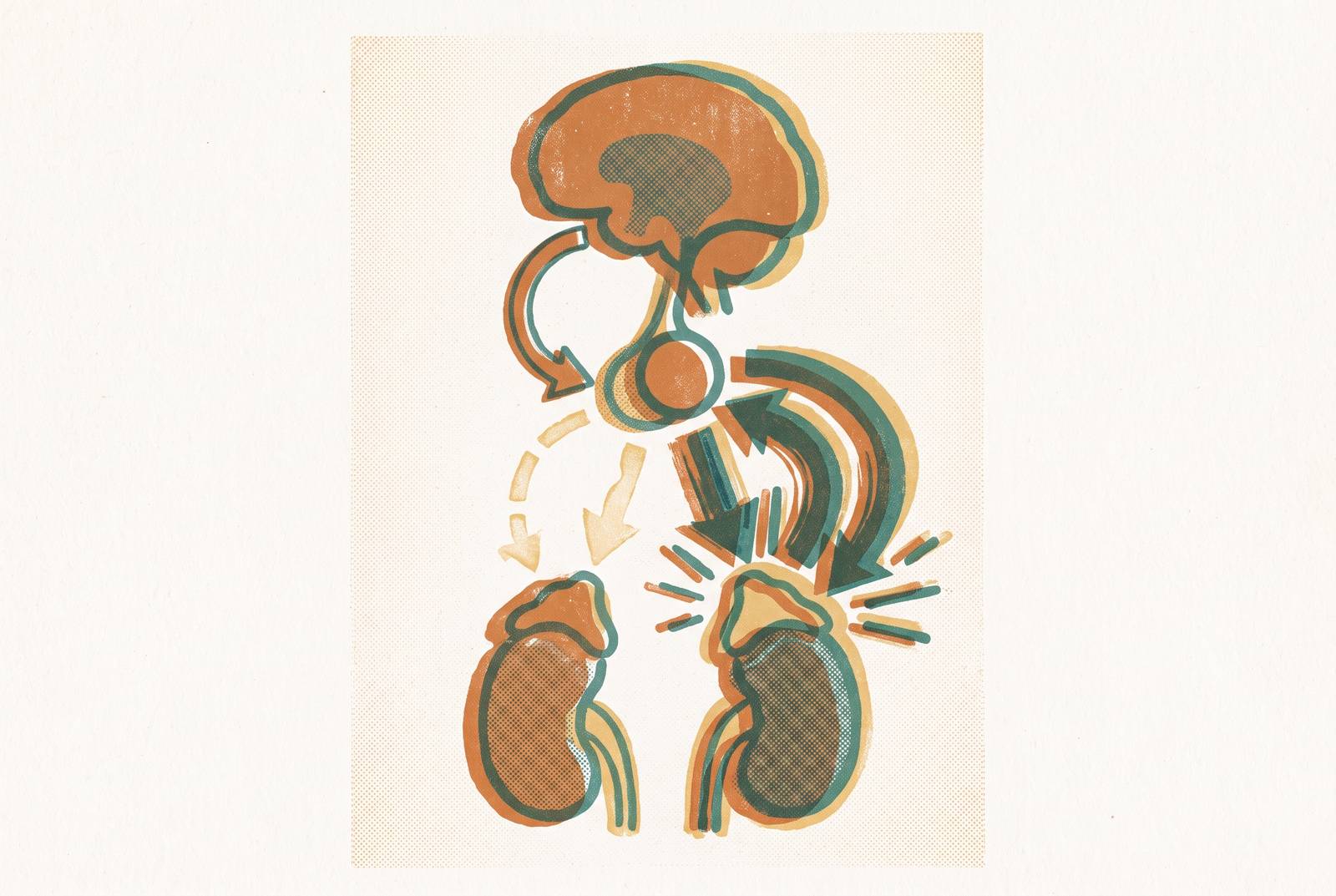
The hypothalamic-pituitary-adrenal axis, or HPA axis, links three structures in a signaling chain. The hypothalamus in the brain releases CRH, which prompts the pituitary to release ACTH. ACTH then signals the adrenal glands to release cortisol. Cortisol also sends a message back to the hypothalamus and pituitary to reduce their activity. This is the system’s negative feedback loop.
A thermostat makes that feedback easier to understand. When the output reaches the required level, the control system reduces the signal that produced it. The HPA axis is built for pulses of activation followed by resolution and recovery. Yet deadlines, conflict, worry about money, and rumination can set off the same system again and again, just as physical threats do. When those pressures remain unresolved, the recovery interval can disappear.
When activation is chronic, the feedback thermostat can become less sensitive. Cortisol receptor responses change, the daily rhythm can flatten or invert, and the response to a new stressor can eventually become blunted. When activation is chronic, it can also lead to glucocorticoid receptor resistance and a pro-inflammatory state. These changes extend beyond the feeling of fatigue. The proposed failure is in regulation.
Conventional endocrinology recognizes Addison’s disease and Cushing’s syndrome as distinct disorders involving dangerously low and dangerously high cortisol, respectively. HPA dysregulation is not interchangeable with either diagnosis. Nor is it a single clinical category that is accepted for everyone whose symptoms fall between those extremes. It is an evidence-backed way to investigate altered signaling, rather than an automatic replacement label for unexplained exhaustion.
How cortisol's circadian architecture makes rhythm damage visible — and measurable
Cortisol output has a shape across the day. The suprachiasmatic nucleus of the hypothalamus acts as the brain’s master circadian clock, coordinating peripheral clocks throughout the body, including the adrenal glands. Adrenal zona glomerulosa cells have their own genetically encoded, self-sustained clocks.
The familiar cortisol pattern is high in the morning and lowest around midnight. That difference helps set the timing of sleep, repair, and metabolic reset. When feedback loses sensitivity, the morning surge can flatten while the evening low rises, weakening the distinction between day and night. “Tired but wired” evenings and waking around 3–4 a.m. can fit this disturbed pattern. They are not, however, enough on their own to identify its cause.
How can a timed pattern be evaluated from one measurement? A single morning blood draw records one point on the curve. Measuring at several times, at least in the morning and evening when checking rhythm, can show whether output is too low in the morning or too high in the evening. Sleep disruption and a blunted response to new stressors provide further context. The distinction is between measuring a concentration and examining its timing.
Why perimenopause makes HPA dysregulation worse — and why the two are so easily confused
Perimenopause changes how the body regulates stress. The Swiss Perimenopause Study in 2021 described declining estradiol and progesterone during the transition, in contrast with increasing cortisol, a marker of HPA activity. That broad direction does not mean reproductive hormones fall smoothly. Longitudinal findings also include temporary estradiol increases. A woman can therefore experience a changing hormonal environment that a simple story of steady decline does not capture.
The Seattle Midlife Women’s Health Study in 2009 found that overnight cortisol tracked most strongly with reproductive hormonal indicators, including E1G, FSH, and testosterone. Psychosocial stress factors showed little relationship when other biological indicators were considered, although epinephrine and norepinephrine were independently significant. The association was not simply with perceived stress. This finding casts doubt on the idea that higher cortisol during the transition must mean a woman is coping poorly with day-to-day pressures. It makes “just manage your stress” an incomplete explanation.
Progesterone provides one mechanism linking reproductive change with HPA regulation. It is metabolized into allopregnanolone, which normally dampens HPA activity through GABA-A receptors. As progesterone falls, that inhibitory brake weakens. The resulting loss of restraint can contribute to excessive nighttime activity and the combination of daytime exhaustion with difficulty sleeping.
Progesterone can fall first while estrogen remains stable or rises in early perimenopause, so normal or elevated estrogen does not describe the whole hormonal picture. Fatigue, brain fog, disrupted sleep, mood instability, and reduced stress tolerance are common to both perimenopause and HPA dysregulation. Which process explains a particular woman’s symptoms, and how much do they interact? Symptoms alone cannot reliably separate those possibilities.
The diagnostic trap: when "adrenal fatigue," perimenopause, and thyroid dysfunction look identical
Perimenopause, thyroid dysfunction, depression, and HPA dysregulation can produce symptoms that are difficult to distinguish without targeted investigation. Fatigue, weight changes, brain fog, mood swings, dry skin, hair thinning, and temperature dysregulation occur across perimenopause and hypothyroidism. Both are common in midlife women and can coexist. Evidence of one can still leave open whether the other is present.
The European Menopause and Andropause Society’s 2024 position statement noted that symptoms including increased sweating, mood swings, anxiety or depression, decreased libido, and menstrual irregularities “can also characterize thyroid disease.” It advised a low threshold of suspicion for thyroid disease in this population. Cycle history can offer a useful clue. Perimenopause classically produces variability, with cycles shortening, skipping, and stretching, whereas thyroid dysfunction more often produces a consistent change in flow or frequency. That distinction guides further investigation.
Accepting “adrenal fatigue” without a workup can delay recognition of hypothyroidism, obstructive sleep apnea, depression, Addison’s disease, or Cushing’s syndrome. Glandular adrenal supplements may contain steroids that initially feel beneficial but can suppress the person’s own adrenal function over time. True adrenal insufficiency is rare but potentially fatal, which makes distinguishing it from a wellness explanation especially important. These possibilities call for proper diagnosis.
What a meaningful hormonal workup actually covers when HPA dysregulation is suspected in perimenopause
A workup needs to look at how these systems may affect one another, since fatigue alone does not point to a lack of just one hormone. The areas to discuss with a clinician include reproductive hormones, cortisol timing, and thyroid function. The question determines how each result is interpreted. A broad collection of numbers without attention to symptoms or timing can be misleading, even when every result falls within its laboratory range.
For reproductive hormones, the proposed panel includes total and free estradiol, progesterone, total and free testosterone, DHEA-S, FSH, and prolactin. Free estradiol is the form that tissues can use. Progesterone needs particular attention to cycle timing because it peaks in the luteal phase. When periods are still regular, day-three FSH is the most consistent way to compare results. A result detached from its place in the cycle loses part of its meaning.
FSH alone is an unreliable marker of perimenopause because it can fluctuate dramatically, even returning to premenopausal levels after an elevated reading. In early perimenopause, elevated FSH can overstimulate remaining follicles and produce higher-than-usual estradiol. A later cycle may involve follicle failure and an estradiol crash. AMH, or anti-müllerian hormone, adds information about remaining follicle count and its decline through reproductive life. Even so, no single blood test confirms perimenopause.
The thyroid tests include TSH, free T3, free T4, and thyroid antibodies. For a question about cortisol rhythm, morning and evening measurements address different parts of the daily curve, with the morning sample capturing the expected high point. These are elements for clinical discussion. The workup must still distinguish altered regulation from established adrenal disease and other explanations.
Repeated testing can reveal the direction and pace of change that a snapshot misses. Hormones change from day to day and even hour to hour during the transition. A cortisol result that looks normal at one moment may be very different from that woman’s earlier pattern, but a clinician still needs to assess what that difference means. Longitudinal hormone data become more useful for explaining a pattern when read with the symptom and cycle history.
Why women with these symptoms are so often sent away without answers
The gap between disabling symptoms and generic reassurance is not best understood as an individual physician’s failure. It reflects structural problems in how perimenopause and HPA dysregulation are taught, coded, and reimbursed. Those limits shape what gets attention at an appointment. A woman may leave without an explanation that connects her changing cycles, disrupted sleep, and declining stress tolerance. The “adrenal fatigue” label thrives in that unanswered space, so correcting the terminology without addressing the dismissal leaves its appeal intact.
How to advocate for a real workup when the system defaults to reassurance
For a woman seeking care, the practical shift is to describe the pattern and ask a specific clinical question. Asking about “HPA axis function” or “cortisol rhythm” is more precise than asking whether the adrenal glands are exhausted. The request should open an investigation by giving the clinician a mechanism to consider while leaving room for thyroid disease, perimenopause, depression, sleep disorders, or another explanation.
A symptom timeline can make that conversation more concrete. It can show when symptoms began, how they relate to cycle changes, and whether energy differs between morning and evening. Recording when fatigue, sleep disruption, or brain fog is worst in the cycle builds a history that one appointment cannot provide. A woman can then ask why a particular test is being ordered and whether its timing will answer the question. Requesting a broader hormonal discussion rather than a lone FSH result, and asking about multiple cortisol time points when rhythm is the concern, follows directly from the biology.
If a provider declines to investigate hormonal contributors to fatigue, sleep disruption, and mood changes in a woman in her 40s without thyroid or adrenal evaluation, a second opinion is reasonable. Options include a gynecologist, an integrative medicine physician, or a specialist in hormonal health. Repeated measurements over months can then be considered in relation to the evolving symptom record. Understanding the correct mechanism changes the encounter’s focus from exhausted glands to questions about signaling, timing, and competing diagnoses. That is how a more accurate explanation becomes a route toward care.
Sources
- Editorial: Circadian rhythm in adrenal endocrinology
- A Review of Hypothalamic-Pituitary-Adrenal Axis Function in Chronic Fatigue Syndrome
- A new model for the HPA axis explains dysregulation of stress hormones on the timescale of weeks
- An Integrative Approach to HPA Axis Dysfunction: From Recognition to Recovery - ScienceDirect
- Chronic Stress and Autoimmunity: The Role of HPA Axis and Cortisol Dysregulation - PubMed