Ferritin as the Missing Variable in Perimenopausal Fatigue
Iron deficiency without anemia may be the overlooked culprit behind your perimenopausal exhaustion.
Fatigue in perimenopause gets attributed almost automatically to hormones. That explanation is often half the story, because ferritin, the protein that stores iron, can be depleted for reasons that have nothing to do with estrogen and everything to do with blood, absorption, and inflammation.
Why ferritin-driven fatigue is not the same as hormone-driven fatigue in perimenopause
The exhaustion of perimenopause rarely responds to a good night's sleep. The reflexive explanation is hormonal: estrogen and progesterone are fluctuating, cortisol is elevated, and the body is adjusting to a new endocrine rhythm. That explanation is accurate as far as it goes. Progesterone tends to decline earlier in the transition than estrogen does, and estrogen itself can swing unpredictably from month to month, so a single hormone panel captures a moment rather than a trend, and a woman tested on a day when estradiol happens to be high can be told her levels look fine, only to feel entirely different two weeks later when the same hormone has dropped.
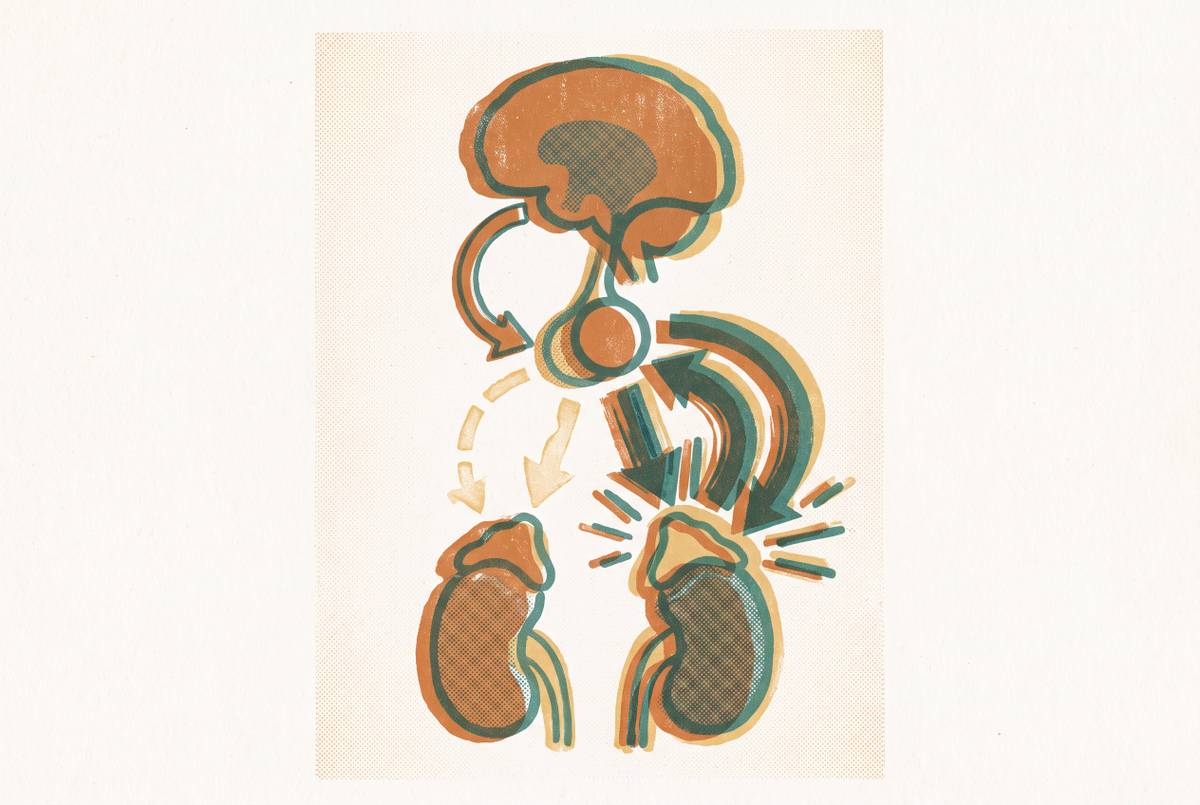
But hormonal fluctuation is not the only mechanism capable of producing this fatigue, and that is the argument this piece is built around. Iron, stored in the body as ferritin, is required for oxygen transport through hemoglobin and serves as a cofactor for mitochondrial energy production and for the synthesis of dopamine and serotonin. When ferritin stores run low, fatigue, cognitive fog, and mood disruption follow through a pathway that has nothing to do with the ovaries. These two systems, hormonal and hematologic, can decline at the same time, independently, in the same woman, producing a symptom picture that looks identical regardless of which one is driving it.
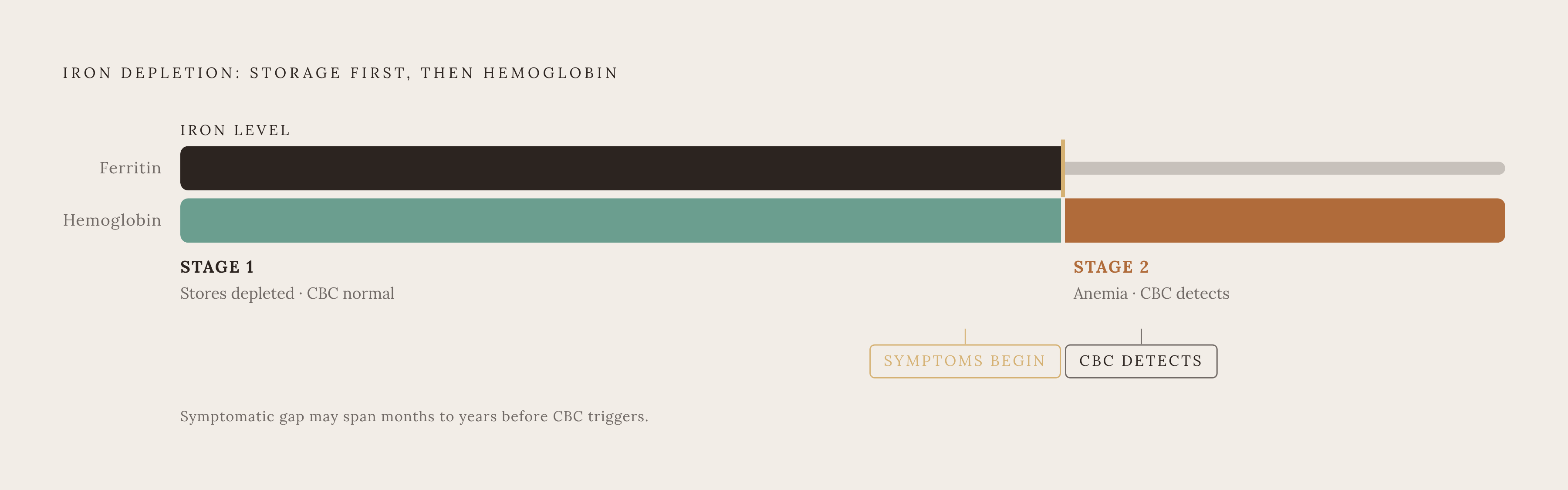
The detail that makes this distinction clinically urgent is that a woman can have depleted ferritin and a completely normal hemoglobin at the same time. That state is called iron deficiency without anemia, and it means a standard complete blood count, the test most women get when fatigue is investigated, returns unremarkable while she remains symptomatic. The body prioritizes hemoglobin over storage. When iron intake can't keep pace with iron loss, reserves get drawn down first while hemoglobin is defended for as long as possible. A woman can run on depleted iron stores for years, reporting the same fatigue at every visit, while every CBC comes back looking normal.
How perimenopause biology specifically depletes iron stores
Perimenopause is not simply a continuation of the iron demands of the rest of reproductive life. It introduces a compounding depletion dynamic, driven by at least three forces operating at once.
The first is heavier and less predictable menstrual bleeding. Research published in the American Journal of Hematology found that as many as 63% of women with heavy menstrual bleeding have iron deficiency or iron deficiency anemia. Perimenopause is precisely the period when heavy, unpredictable bleeding tends to increase. Fibroids and adenomyosis, both more common in this age group, add further blood loss on top of that pattern.
The second force works on the absorption side. As estrogen becomes erratic and trends downward over the course of the transition, that regulatory support weakens. More iron is lost through bleeding while less iron is absorbed from the diet to replace it, a double exposure.
The third force is inflammatory. The low-grade chronic inflammation associated with the menopausal transition causes the body to sequester iron into storage rather than releasing it for red blood cell production. Iron stores can look adequate on a lab report while remaining functionally inaccessible to the tissues that need them. Ferritin is an acute-phase reactant, so inflammation, infection, obesity, or liver disease can all push its measured value artificially higher and mask a true deficiency underneath. That is part of why ferritin needs to be read alongside transferrin saturation and inflammatory markers as a number in context.
Why the symptom overlap makes ferritin depletion almost invisible without testing
Iron deficiency without anemia and hormonal perimenopause produce nearly identical symptom lists. A clinician looking at a perimenopausal woman reporting these symptoms has every reason to suspect hormones first, because hormones are the known, expected driver of this life stage. That is a structural consequence of two conditions that happen to look the same from the outside.
What exactly breaks the deadlock between these two explanations? Iron deficiency is measurable, and it is correctable, usually within weeks once it's identified and treated. Hormonal fluctuation is also measurable, but its trajectory, not a single snapshot, is what matters, and its correction is a longer and more variable process. The two conditions are distinguishable, but only through testing, never through symptom description alone.
The overlap deepens further once ferritin's role in neurotransmitter production is taken into account. Iron is a cofactor in the synthesis of dopamine and serotonin, and ferritin is the biomarker that reflects how much iron is actually in storage to support that synthesis. Depleted ferritin can produce depression and anxiety symptoms that are clinically indistinguishable from the mood changes typically attributed to estrogen fluctuation. One might argue this is where the stakes of misattribution are highest: women presenting with these symptoms are frequently routed toward psychiatric evaluation and treatment, and mood symptoms that may have a physiological basis in iron or hormone deficiency get treated as primary anxiety or depression, with the underlying iron deficiency left unexamined and unaddressed.
Why standard lab panels are built to miss iron deficiency in this population
A CBC measures hemoglobin. It does not measure ferritin, and because iron deficiency without anemia is defined precisely by normal hemoglobin alongside depleted stores, a CBC will not detect it. Ferritin is not part of a routine blood panel. In perimenopause, ferritin is frequently the single test most likely to explain the fatigue a woman is reporting, and it has to be specifically requested to be included.
Even when ferritin is tested, a second problem compounds the first: the reference ranges labs use to flag an abnormal result were built to catch severe, hospital-level iron deficiency across a broad population. A physiologically based analysis published in Blood Red Cells & Iron identified ferritin thresholds considerably higher than the recommendations currently used by the WHO and the CDC, for both premenopausal and postmenopausal women. Applied in practice, those thresholds would reclassify a meaningful number of women currently being told their ferritin is normal.
A separate study from 2025, affiliated with Yale and published in The Journal of Applied Laboratory Medicine, tested what happens when the ferritin threshold used for screening is raised from the commonly used floor to a higher cutoff. A large share of women with genuine iron deficiency are currently being missed by the reference interval most labs still use by default.
The consequence of this gap is concrete. A woman can receive a ferritin result that falls within her lab's stated normal range, be told her iron is fine, and continue experiencing fatigue, fog, and mood disruption that are, in fact, driven by iron deficiency. The floor was set for a population that doesn't reflect the ongoing menstrual blood loss common to women in this stage of life.
Components of a complete ferritin workup
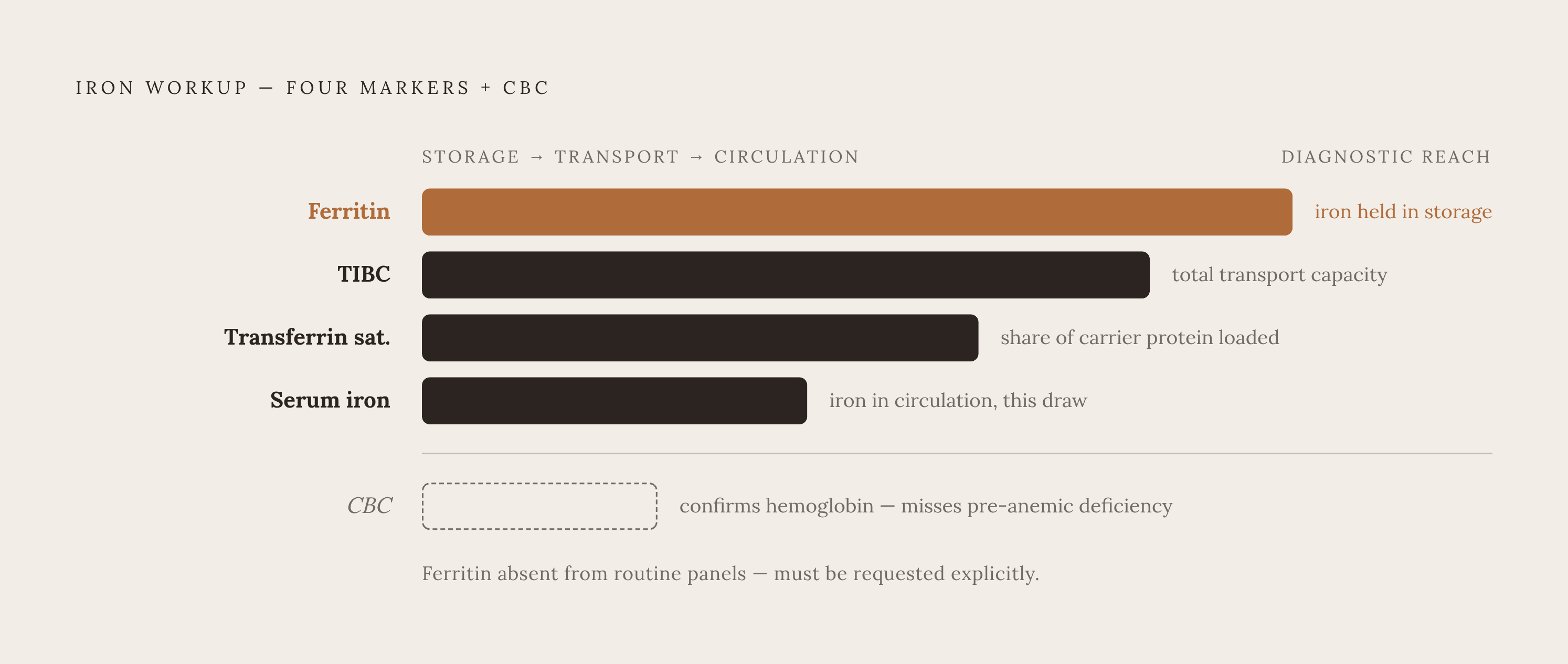
A single ferritin number, read in isolation, is not a complete answer. A meaningful workup requires a panel of markers interpreted together, against a threshold appropriate for a menstruating woman rather than the general reference range printed on the lab report.
The full iron panel has four components. Ferritin reflects how much iron is held in storage. Serum iron reflects how much iron is actively circulating in the blood at the moment of the draw. Transferrin saturation shows what proportion of the body's iron-transport protein is actually carrying iron, giving a sense of how much iron is truly available for use in the system. Total iron binding capacity, or TIBC, rounds out the picture by indicating how much transport capacity exists. A CBC is still necessary alongside these four to evaluate hemoglobin and confirm whether anemia is present or absent, since it will not catch iron deficiency without anemia on its own.
Because ferritin is an acute-phase reactant, it can mislead when read by itself. Reading the two together is what prevents a false reassurance of "normal."
Thresholds for what counts as deficient are still being actively worked out, and the honest picture includes that uncertainty. Iron deficiency is generally flagged when ferritin falls below 30 µg/L in a symptomatic woman, though research suggests symptoms can appear even when ferritin is between 30 and 50 µg/L. The PREFER randomized controlled trial enrolled iron-deficient, fatigued premenopausal women using a specific definition: ferritin below 50 µg/L combined with transferrin saturation below a defined threshold, or ferritin below 15 µg/L with hemoglobin that was normal or only borderline low. Separately, hematology clinicians in practice often target ferritin levels higher than the floors most labs currently use, particularly in cases involving hair loss, which suggests that clinical experience is running ahead of where reference ranges currently sit.
Two more tests belong alongside this panel. The underlying cause also matters for where to look next: in a menstruating perimenopausal woman, heavy cycles explain the great majority of iron deficiency cases, but in a postmenopausal woman, new iron deficiency should prompt an evaluation for gastrointestinal blood loss.
Evidence on correcting iron deficiency
Iron deficiency without anemia is not a finding to note and set aside. Correcting it produces improvement that is both measurable and relatively fast, particularly in fatigue, cognitive function, and quality of life.
The PREFER trial, a randomized, placebo-controlled study of iron-deficient premenopausal women with unexplained fatigue and hemoglobin that was normal or only borderline low, found that a single dose of intravenous ferric carboxymaltose significantly reduced fatigue compared with placebo. A post-hoc analysis published in the American Journal of Hematology in 2024 looked at intravenous ferric derisomaltose in women with iron deficiency anemia tied to abnormal uterine bleeding, a population that maps closely onto heavy-bleeding perimenopausal women, and documented improvement in fatigue measured on the FACIT Fatigue Scale over eight weeks.
Recovery does not arrive all at once, and setting expectations around its timeline matters. Energy and exercise tolerance tend to improve within the weeks following repletion, and restless legs, when the cause is iron-related, often ease over a similar window. Cognitive fog does tend to lift, but generally more slowly than raw energy does.
Treatment route depends on the size of the deficit and how fast it needs to close. Intravenous iron closes a larger deficit in one or two visits and becomes the practical choice when tablets aren't tolerated or when ongoing blood loss outpaces what oral supplementation can replace.
Critics raise the strongest objection to treating sub-anemic ferritin levels. Critics point out that lowering the threshold for treatment, and expanding who gets treated as a result, increases the overall burden of treatment without the backing of randomized trial evidence showing benefit at purely subclinical levels in every population. That objection deserves a direct answer rather than a dismissal: this remains an evolving area of evidence, the PREFER trial and the research alongside it provide real support for treating sub-anemic deficiency in symptomatic women, and clinical judgment guided by symptoms, not the reference range alone, remains essential to deciding who benefits from treatment.
None of this should be read as a claim that correcting iron resolves every symptom of perimenopause. The honest claim is narrower and still significant: the fatigue attributable to iron deficiency is reversible, and that reversibility is worth pursuing on its own terms.
Bringing ferritin into the conversation with a clinician
Ferritin is absent from standard panels, and the reference ranges used to interpret it when it is tested are calibrated for a population broader than perimenopausal women with ongoing menstrual blood loss. Getting a complete answer requires asking for it directly, since the system as currently structured does not surface it by default.
A few concrete requests make the difference. Ask for a full iron panel specifically, meaning ferritin, serum iron, transferrin saturation, and TIBC together, not a CBC alone, since a CBC will not reveal iron deficiency without anemia no matter how many times it's repeated. Ask what reference range floor the lab is using for ferritin, and treat a result inside that stated normal range with some skepticism given what current research on thresholds suggests about where that floor actually sits. Request thyroid function and B12 be tested alongside iron, so that one problem isn't treated while others continue unexamined in the background. And if heavy or unpredictable bleeding is part of the picture, name it explicitly in the conversation, both because it's a symptom that deserves attention in its own right and because it is a direct, identifiable driver of the iron loss being investigated.
A single ferritin result is a snapshot, not a verdict. Because ferritin can be pushed up by inflammation and can shift somewhat with cycle phase, a baseline test followed by a repeat test after treatment, or at a different point in the cycle, shows something a one-time result cannot: whether iron stores are genuinely being rebuilt or whether the number was misleading from the start. That second data point is what turns a lab result into actual information.
Sources
- Effect of Ferric Derisomaltose on Fatigue in Iron Deficiency Anemia Associated With Abnormal Uterine Bleeding
- Physiologically based serum ferritin thresholds for iron deficiency in US older adolescents and adults
- Evaluation of a Single Dose of Ferric Carboxymaltose in Fatigued, Iron-Deficient Women – PREFER a Randomized, Placebo-Controlled Study
- Prevalence of Ferritin Testing, Iron Deficiency, and Iron Supplementation Among Women with Fatigue in Ambulatory Care
- Effect of Ferric Derisomaltose on Fatigue in Iron Deficiency Anemia Associated With Abnormal Uterine Bleeding
- Diagnosis and management of iron deficiency in females
- Ferritin Levels Redefined: Optimal Threshold for Women