Perimenopausal Mood Disorder Misdiagnosed as Psychiatric Illness
Psychiatric screening tools can't distinguish hormonal symptoms from actual mental illness.
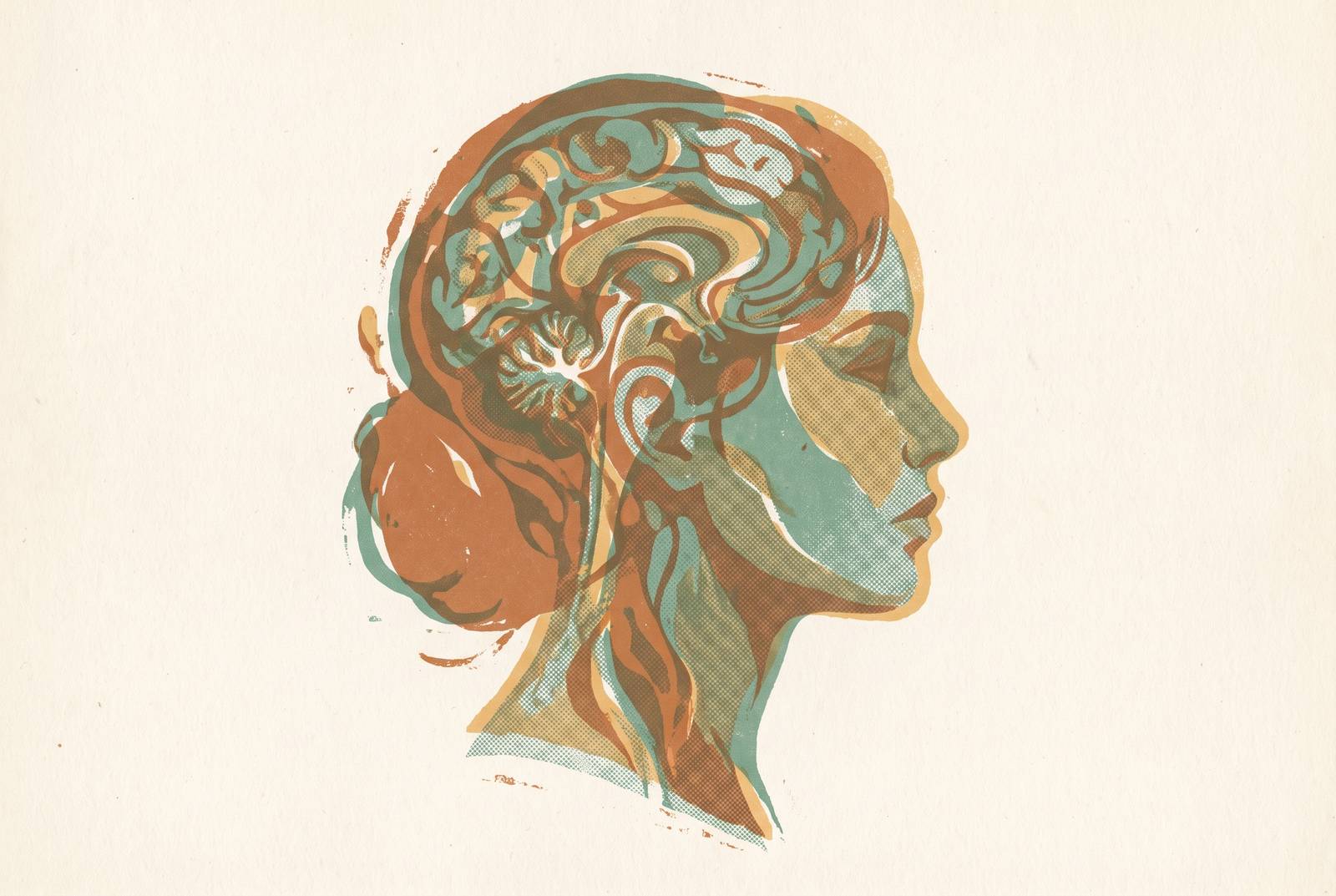
Perimenopausal mood changes are being diagnosed as primary psychiatric illness at a scale the data can now quantify, not just describe anecdotally.
What the data show about perimenopause misdiagnosis
A 2025 survey commissioned by Biote, fielded among more than 1,000 U.S. women ages 30 to 60, found that roughly two in five felt they had been misdiagnosed when they sought care for perimenopause symptoms. That is not a fringe result reflecting a handful of bad encounters. Of the women who reported misdiagnosis, roughly a third of all respondents were treated for anxiety, more than a quarter for depression, and a quarter for mood swings specifically, with a smaller share treated for panic attacks. Among women who were prescribed mental health medication at some point in this process, roughly two in five came to believe the diagnosis behind that prescription had been wrong.
The word "diagnosed," not "missed," is what matters in this figure, and the system did not fail by inaction. It failed by acting on the wrong model of what was happening in these women's bodies.
A 2024 clinical study published through PMC and Cureus examined women diagnosed with depression at a tertiary care hospital and found that a large majority of them had significant perimenopausal symptoms that had been overlooked at the time of diagnosis. Two independent lines of evidence, a self-report survey and a clinical chart review, converge on the same conclusion. That convergence is what turns this from a plausible complaint into a documented pattern.
Standard psychiatric screening tools and hormonal mood symptoms
The tools clinicians use to screen for depression and anxiety were built to catch those conditions in a general population, and they do that job well.
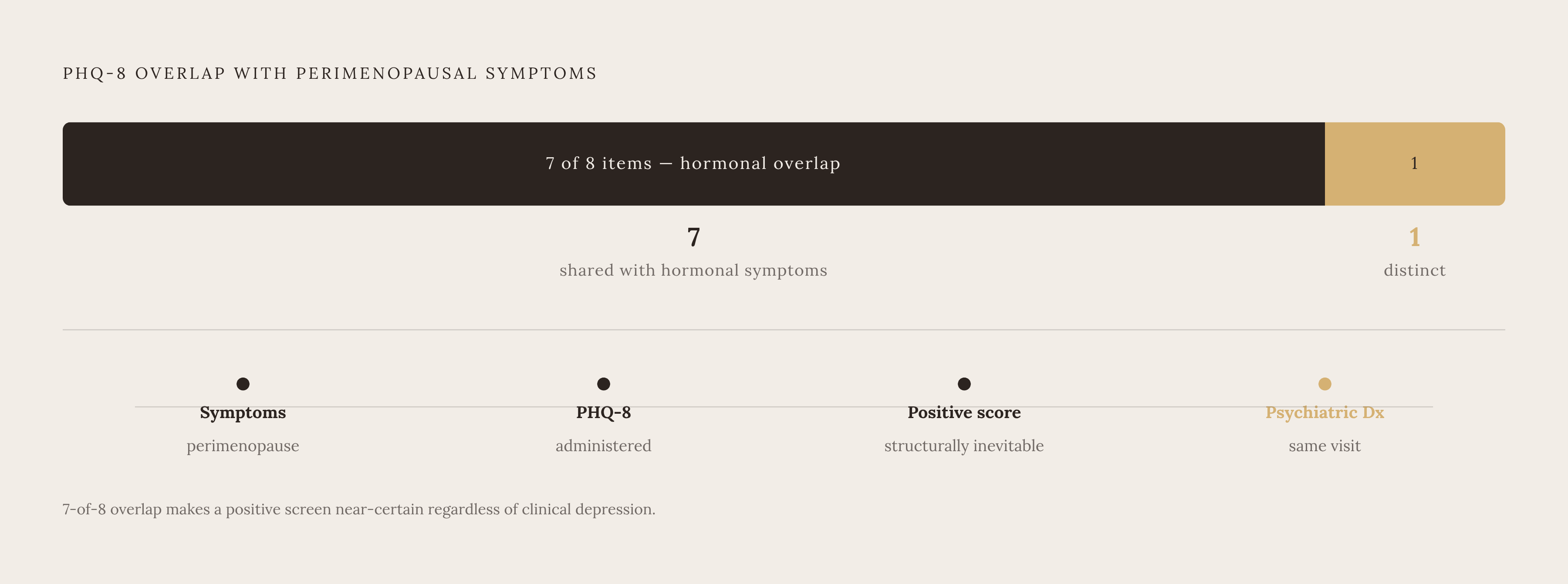
A standard eight-item depression screening questionnaire is one of the most widely used depression screening tools in primary care. A clinician who administers the PHQ-8 to a perimenopausal patient is almost certain to generate a score in the depression range regardless of whether clinical depression exists, simply because the symptom list and the hormonal symptom list overlap by seven items out of eight.
The same structural problem appears on the anxiety side. The screen has no mechanism for asking which one produced the symptom. It was built to detect a pattern, and both conditions produce the same pattern.
What results is close to a funnel. A woman arrives with symptoms, completes a validated screening tool, scores positive for a mood disorder, and receives a psychiatric diagnosis, often within a single visit. Nobody involved in that encounter necessarily did anything wrong by the standards of the tool. The question nobody asked, whether her menstrual cycle had changed in the past year, sits entirely outside what the PHQ-8 or a standard anxiety screen is built to capture. That is a category problem in the design of the instrument.
The training gap that makes clinicians miss the hormonal context entirely
If the tools cannot catch the distinction on their own, the question becomes whether the clinicians using them are trained to catch it instead. For the majority of U.S. physicians who see perimenopausal women, the answer is no, and the gap is documented rather than assumed.
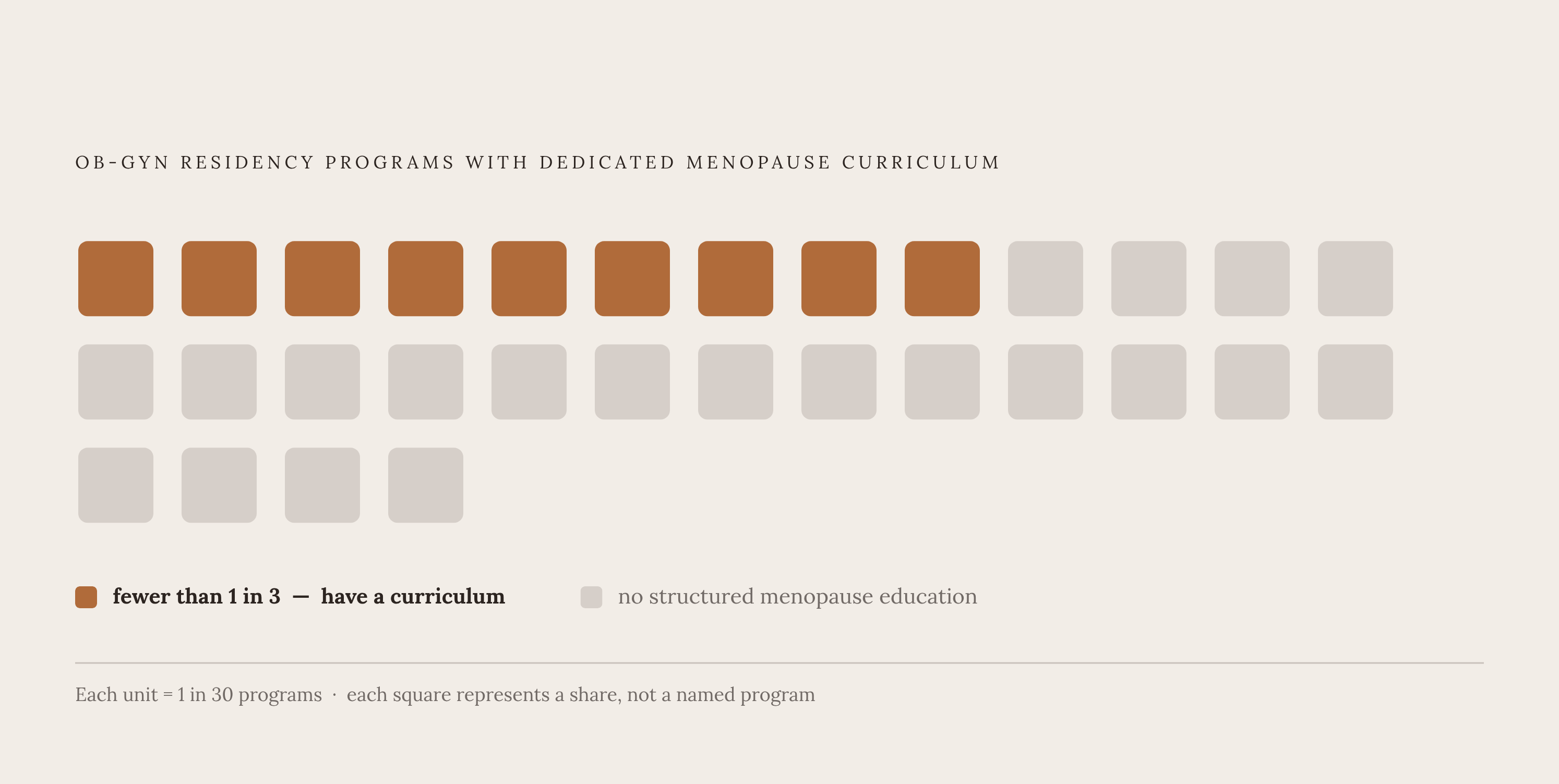
Fewer than a third of U.S. OB-GYN residency programs include a dedicated menopause curriculum. OB-GYNs are the specialists a woman is most likely to expect recognition from, and most of them complete their training without a structured curriculum on the transition itself. It reflects an absence at the level of how medical education has been structured around this life stage.
That absence compounds with a second pattern: age bias. Women in their late 30s and early 40s are routinely told they are too young for perimenopause, a judgment the biology does not actually support. When a clinician's mental model places perimenopause in a woman's early 50s, a 39-year-old presenting with anxiety and sleep disruption is unlikely to prompt the question that would surface the real cause.
Faced with a system unlikely to raise the hormonal explanation on its own, women largely go looking for it themselves. In the Biote survey, roughly two in five turned to Google and, separately, roughly two in five turned to family members for information about what they were experiencing. Understood this way, the pattern is institutional rather than personal. No single clinician is negligent for not learning a curriculum their residency never offered.
What is biologically happening to the brain during perimenopause
The symptoms described so far feel psychiatric because they appear in mood, cognition, and behavior. Their origin, however, is neuroendocrine. Estrogen is a direct regulator of several of the brain's core mood systems, including serotonin, which governs mood stability, GABA, which governs calming signals, cortisol, which governs the stress response, and the circuitry that controls sleep-wake cycles, not merely a reproductive hormone with side effects on the brain. During a normal, gradual hormonal decline, these systems can adjust in step. Estrogen spikes and crashes unpredictably across the transition, and when it does, it destabilizes all four of these systems at once rather than one at a time. That simultaneous disruption is what produces the specific cluster so often mistaken for a primary anxiety or mood disorder: sudden anxiety, racing thoughts, heart palpitations, insomnia, and an unshakable sense of dread.
A mechanism at the receptor level explains why this happens. Estrogen acts in the brain by binding to estrogen receptors, and estrogen receptor beta in particular appears to play a role in anxiety- and depressive-like behavior. NIMH research has also found that women who experienced depression during perimenopause can see mood symptoms return if estrogen therapy is later stopped. That detail carries real diagnostic weight: if a mood symptom reliably tracks the presence or absence of estrogen, the symptom is estrogen-dependent, not evidence of an independent psychiatric illness that happens to coincide with hormonal change.
A second, less appreciated piece of the biology involves timing. When progesterone drops relative to estrogen, even while estrogen itself remains within a statistically normal range, the result can be irritability, bloating, breast tenderness, and mood instability. A hormone panel can come back looking unremarkable, leading a clinician to reasonably conclude hormones are not the driver, and the mood symptoms get reassigned to a psychiatric cause that was never actually confirmed, only left standing by default.
Stage itself carries independent risk. Women in the perimenopausal phase show a substantially elevated risk of developing major depressive disorder regardless of prior psychiatric history, and that elevated risk is specific to the stage of the transition rather than a sign of some pre-existing vulnerability finally surfacing. The biology, in other words, is doing something to the brain during this window that it is not doing before or after it.
Where hormonal mood symptoms and psychiatric disorders genuinely overlap
None of this means hormonal symptoms and primary psychiatric disorders are always easy to tell apart on sight. What differs is the pattern: onset, timing, accompanying physical symptoms, and response to treatment, each of which offers a clinician a usable signal if someone asks the right question.
Several signals point toward a hormonal origin rather than a primary psychiatric one. And treatment response itself is a clue. A partial, incomplete response to SSRIs or standard anxiety therapy, where mood improves somewhat but never fully resolves, suggests the underlying driver has not actually been addressed.
The overlap with adult ADHD deserves its own attention, because it runs through the same dopamine pathways rather than the serotonin and GABA systems discussed above. Fluctuating estrogen affects dopamine regulation, the same system implicated in ADHD, which can produce concentration difficulties, memory lapses, and impulsivity that look like new-onset ADHD or an ADHD relapse. The distinguishing factor is chronological rather than symptomatic: perimenopause-linked cognitive symptoms appear in midlife without a childhood or young-adult history, while genuine ADHD can usually be traced back to an earlier stage of life. A 2025 population-based cohort study found that women with ADHD have a higher prevalence of severe perimenopausal symptoms and experience them at an earlier age than women without ADHD. The two conditions do not just resemble each other. They can coexist and intensify one another.
The overlap carries particular stakes for women with pre-existing severe mental illness. A 2024 paper in BJPsych Bulletin identifies a specific hazard it calls diagnostic overshadowing: new-onset perimenopausal symptoms in a woman with an existing psychiatric diagnosis are likely to be read as a relapse of her known condition rather than recognized as a distinct hormonal presentation. The paper argues clinicians need to ask these patients directly about menopausal symptoms, because patients managing a severe mental illness are unlikely to draw the connection themselves. The paper also flags an iatrogenic wrinkle: antipsychotics and some other psychotropic medications suppress ovarian hormone production through the hypothalamic-pituitary-gonadal axis, which can worsen or accelerate perimenopausal symptoms that the treatment itself has no way of flagging as its own side effect.
Two further rule-outs belong in this same conversation. Thyroid dysfunction belongs on every list of rule-outs, since thyroid conditions can mimic almost the entire perimenopausal symptom set, and TSH testing should be a standard part of any workup that is already looking at mood and hormones together.
None of this is a self-diagnosis checklist. These patterns exist to equip a conversation with a clinician, not to replace one. A woman recognizing her own symptoms in a cyclical pattern or a 3 a.m. wake time is not qualified to rule out a psychiatric disorder on her own, and should not try to. What she can do is walk into an appointment with the specific question that the standard screening tools were never built to ask on their own.
What hormone testing can and cannot tell you
Hormone testing is not a switch that flips to "perimenopause: confirmed" or "perimenopause: ruled out." Major clinical bodies, including NICE, ACOG, and The Menopause Society, hold that routine hormone testing is not required to diagnose perimenopause in women over 45 who have typical symptoms. Testing becomes clinically important specifically in younger women, in atypical presentations, or in cases where mood symptoms alone are driving the clinical picture without the more recognizable physical signs.
Access to that testing is itself uneven. Among the women who did get tested, roughly a third received no meaningful follow-up discussion of what the results meant, including women told only that their results were "normal" with nothing further explained.
Three hormones matter most, and each carries its own timing requirement. FSH is ideally drawn on cycle days 2 through 5, the early follicular phase, where an elevated reading suggests a later stage of the menopausal transition under the STRAW+10 staging framework. Hormonal contraceptives suppress natural FSH production as well, which makes results unreliable for perimenopause assessment unless that detail is disclosed to the ordering clinician.
Estradiol tells a similarly incomplete story in isolation. High estradiol early in the follicular phase can even suppress FSH into a normal-looking range on a combined panel, creating a false sense that nothing is happening hormonally when something clearly is.
Progesterone is where the clinical trap described earlier becomes most visible. A level below a meaningful threshold in that specific window indicates anovulation, and anovulatory cycles produce very low progesterone even while estrogen looks entirely normal elsewhere on the panel. Relative progesterone deficiency can produce irritability, anxiety, and sleep disruption without ever triggering an abnormal estrogen reading to flag the problem, which is the exact mechanism behind the mood symptoms so many women are told have no hormonal explanation. Without that interpretation, the number on the page carries very little diagnostic weight for a perimenopausal woman.
The unreliable foundation of a single hormone test
Everything in the previous section points toward the same conclusion from a different angle: a single hormone panel, drawn on a single day, captures one frame of a process that is defined by its instability. Progesterone only means anything if it is drawn in a seven-day window after ovulation, and an anovulatory cycle can hide a real problem behind an estrogen reading that looks fine.
A woman's hormonal pattern during perimenopause is, by definition, not a fixed state that one test can characterize. The same logic that applies to FSH and estradiol applies with even more force to progesterone, given how dependent its interpretation is on exact cycle timing. Testing once, getting a number back, and treating that number as a verdict mistakes a single measurement for the underlying process generating it, the same error the PHQ-8 makes when it reads a symptom list without context.
Repeated measurement across cycles is what allows a clinician to see the arc rather than a single point on it: whether FSH is trending upward over several months, whether progesterone is consistently low across multiple luteal-phase draws, whether estradiol's swings are widening over time. None of that is visible in one blood draw, however carefully timed. The case for hormone testing in perimenopause is an argument for testing with an understanding of what a test, run once, can and cannot show, and for treating a "normal" result as a data point in an ongoing picture rather than as a closed case.
Sources
- Severe mental illness and the perimenopause
- Evaluating tools for assessing mental health disorders in perimenopausal women - PubMed
- Perimenopause linked with higher risk of bipolar and depression
- Mental health consultations during the perimenopausal age range: a qualitative study of GP and patient experiences
- Perimenopausal syndrome and mood disorders in perimenopause: prevalence, severity, relationships, and risk factors
- REVIEW ARTICLE Menopause and Psychiatric Illness: A Gynecologist’s Approach
- The brain in transition: Perimenopause through a translational lens - ScienceDirect
- Menopause and mental health: clinical evidence and public discourse - PMC