Progesterone Decline and GABA Receptor Sensitivity
Progesterone loss desensitizes brain receptors that regulate mood and sleep.
Perimenopause is usually narrated as an estrogen story, hot flashes, night sweats, the slow fade of a hormone everyone has heard of. But that framing leaves a gap wide enough to drive a diagnosis through: it does not explain why a woman in her mid-40s who has always slept fine, handled a demanding job, and felt reasonably like herself can wake up one year finding that none of it holds anymore, and no one around her, including her doctor, can say why. Progesterone is the piece missing from that account, because its job in the brain has nothing to do with reproduction and almost nothing to do with what most perimenopause content bothers to mention. What follows traces that mechanism from the molecule to the symptom, and asks why so much of clinical medicine still isn't looking for it.
Progesterone's role in the brain before it starts to fall
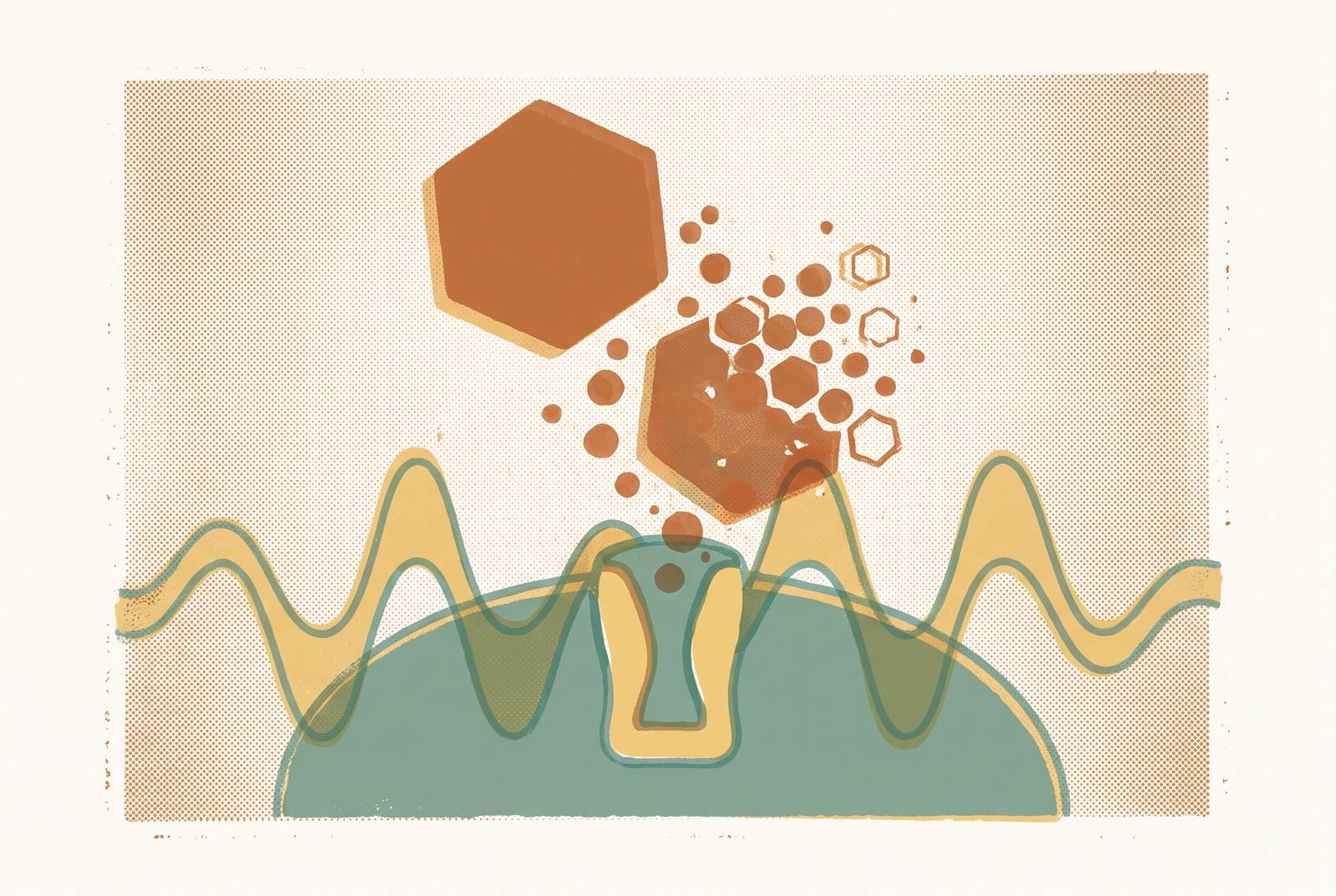
To understand what perimenopause takes away, it helps to understand what's there beforehand, working quietly enough that almost nobody notices it.Progesterone gets converted, in the brain and elsewhere in the body, into a neuroactive steroid called allopregnanolone, or ALLO. ALLO's job is to bind to and potentiate the GABA-A receptor, which is the molecular switch through which gamma-aminobutyric acid, the brain's main inhibitory neurotransmitter, actually does its work. Think of the GABA-A receptor as a brake pedal wired into the brain's excitatory circuitry: press it, and overactive neurons quiet down. ALLO doesn't replace the brake, it makes the pedal more responsive.
When that system is well-supplied and the receptors are properly sensitized, pyramidal neurons (the brain's excitatory workhorses) stay in check, the stress response stays regulated, sleep holds together, and mood stays roughly where it should. The 2023 Frontiers in Psychiatry review by Gao and colleagues lays this out clearly: ALLO sustains GABA-A receptor sensitivity, and through that sensitivity, it maintains inhibitory control over the exact neural circuits responsible for anxiety and stress reactivity. The pharmaceutical industry has spent decades building drugs that mimic this exact pathway for that reason. Benzodiazepines and alcohol work this same pathway too, which is less a coincidence than a signal of how central this switch really is.
During the reproductive years, this supply is cyclical and dependable.Ovulation produces a corpus luteum, the corpus luteum produces progesterone, progesterone rises through the luteal phase, and ALLO rises with it. Once a month, in other words, the brain gets a neurosteroid top-up that reinforces its own inhibitory tone. It is easy to take a system like this for granted precisely because it works so reliably, until it doesn't.
Progesterone as the first hormone to become unreliable in perimenopause
The estrogen-centric telling of perimenopause implies a fairly steady, linear fade. Progesterone's arc is different, and it starts earlier than most women expect. Because progesterone depends entirely on ovulation, and specifically on the corpus luteum that forms after it, there is a hard biological rule at work: no ovulation, no corpus luteum, no progesterone, full stop. As cycles in the early 40s, and sometimes as early as the mid-30s, become less consistently ovulatory, progesterone production doesn't decline smoothly.It becomes an intermittent pulse, present some cycles and absent in others.
Estrogen, meanwhile, is doing something almost opposite. Rather than a steady decline, it swings, rising, falling, occasionally spiking well above what would be considered a normal premenopausal level. The variability itself is the disruptive part, not simply the direction of change. That distinction matters because it means a woman can be, at the exact same moment, hormonally "normal" by the estrogen numbers her doctor checks and significantly deprived of neurosteroid support by the progesterone her doctor probably didn't check.
Sequence is the whole argument here. Progesterone deficiency tends to be the first hormonal shift of perimenopause, arriving before estrogen has changed in any way a standard test would flag. The average age of perimenopause onset is 46, with the transition lasting approximately 5 years, though other sources say it can begin as early as the mid-30s and last anywhere from two to ten years. A 2026 review goes further, describing perimenopause as a period of structural, functional, metabolic, and molecular remodeling across the brain, one that can begin before a single irregular cycle or hot flash occurs. The neurology, in other words, arrives before the symptoms everyone's been told to watch for.
What happens in the brain when allopregnanolone levels drop
At this point the mechanism moves from background detail to explaining the lived experience directly. When ALLO falls quickly, or falls in the erratic, on-again-off-again pattern that intermittent ovulation produces, GABA-A receptors lose sensitivity.The brake pedal goes soft.Inhibitory control over excitatory neurons weakens, and the brain becomes measurably more reactive, a direct biological account of anxiety, insomnia, and emotional instability, not a byproduct of stress or circumstance layered on top.
The cascade, as described in the Gao et al. review, runs in a specific sequence: ALLO drops quickly, GABA-A receptor sensitivity falls, chloride influx through the receptor drops with it, GABAergic neurons lose their inhibitory grip on pyramidal neurons, and pyramidal neuron excitability rises. Chloride influx is the actual mechanical step that makes a neuron quiet down. When it's reduced, the neuron simply doesn't get the "stand down" signal it used to. Sharp declines in circulating progesterone, and by extension in brain ALLO (technically 3α,5α-THP), are associated with both anxiety and increased seizure susceptibility.The seizure link has been quantified: withdrawal from progesterone produces a sixfold decrease in the decay time of GABA currents, so the inhibitory signal that should linger and calm the neuron clears out far too fast to do its job.
The downstream effects extend past the receptor itself. Losing progesterone can destabilize the HPA axis, the adrenal stress-response system; Lara Briden's clinical writing on the subject holds that this is part of why perimenopause carries elevated risk for anxiety, depression, and insomnia. And this isn't only theoretical. A 2022 study using 3T ¹H-MRS imaging, published in the International Journal of Neuropsychopharmacology by Tran and colleagues at the University of Alberta, found decreased GABA+ levels in the medial prefrontal cortex of perimenopausal women, an in-vivo, objectively measured drop in inhibitory neurotransmitter concentration in a brain region central to emotional regulation. The same study found perimenopause carries increased risk for a first major depressive episode, with a meaningful number of women experiencing their first one during this exact window.
Brexanolone (Zulresso), a synthetic form of allopregnanolone, was FDA-approved in 2019 for postpartum depression (a condition driven by the same ALLO withdrawal mechanism) and produced rapid, significant improvements in depression scores persisting for 30 days after treatment, before the manufacturer withdrew it from the market in 2025 to focus on its oral alternative, zuranolone (Zurzuvae). A drug doesn't get built around a receptor pathway by accident.
2023 review reframes it as a disorder of suboptimal sensitivity to neuroactive steroid hormones, with pathophysiology rooted in GABA-A receptor sensitivity changes; perimenopause produces a more sustained and eventually permanent version of the same disruption. Perimenopause is, in a sense, PMDD stretched out and made permanent, the same withdrawal mechanism playing out over years instead of days.
The rate and pattern of ALLO decline matters as much as the decline itself
If it's really about low progesterone, why do some women with fairly modest hormonal changes feel wrecked, while others with more dramatic drops report barely noticing? The answer seems to lie less in the absolute level of ALLO and more in how fast, and how unpredictably, that level moves.The GABA-A system appears to respond to the speed and pattern of change, not just the raw number.An erratic fluctuation can do more neurological damage than a low but steady state ever would.
That reframes what perimenopause actually is at the hormonal level. It is less a gradual deficiency than a loss of cyclical predictability, the brain trying to calibrate itself to a signal that refuses to hold still.GABA-A receptors adjust their own subunit composition in response to sustained neurosteroid exposure, and a rapid withdrawal, even from what was recently a perfectly normal level, can trigger more excitability than a receptor that has simply adapted to chronic low supply. The nervous system isn't settling into a new baseline.It's chasing one that keeps moving.
Individual sensitivity adds another layer. Research published in Frontiers in Behavioral Neuroscience in 2024 describes a U-shaped relationship between ALLO and mood, meaning some women's brains are simply more reactive to hormonal fluctuation than others. Women with a history of PMDD or premenstrual mood sensitivity may be at particular risk here, since their GABA-A systems have already demonstrated, cycle after cycle, a heightened response to luteal-phase ALLO shifts. Body composition plays a role too: data drawn from PMC6082400 shows that obesity is linked to lower LH, FSH, estradiol, and progesterone secretion overall, along with a blunted FSH rise and a less steep estradiol decline across the transition. Put differently, the shape and timing of ALLO loss is not one universal curve. It differs person to person, so one woman's chart can look "unremarkable" while she is, in fact, living through significant neurological volatility. The unpredictability that makes this so hard to capture on paper is the same unpredictability that makes it so hard to live through.
How this mechanism produces the specific symptoms women report
Once the mechanism is clear, the symptom list stops reading like a vague cluster of complaints and starts reading like a set of predictable outputs. Anxiety follows directly from reduced GABAergic inhibitory tone: the amygdala and its surrounding stress circuits lose suppression, and the nervous system starts treating ordinary stress, a delayed email reply, a loud room, as a threat it has no way to dampen. Insomnia follows the same logic. GABA-A receptor activity underpins the architecture of sleep itself, particularly slow-wave and non-REM stages, so a drop in ALLO support fragments sleep at a physiological level, not because of racing thoughts or bad sleep hygiene. Emotional instability and irritability track the same curve: heightened pyramidal neuron excitability lowers the threshold at which a small provocation produces an outsized response, because the mechanism that used to absorb it is underperforming.
Low stress tolerance rounds out the picture. Lara Briden's account holds that with the HPA axis destabilized, cortisol regulation gets looser, and a woman can genuinely be handling stress worse this year than last, even though nothing about her external circumstances has changed. Notice that this is the same symptom cluster PMDD produces (emotional instability, irritability, depression, anxiety), just compressed into days instead of spread across years, sharing a mechanism though not a timeline.
This is precisely where things go wrong in the exam room. A 2025 qualitative study in the British Journal of General Practice found that GPs can prematurely narrow their own information-gathering when they fail to connect a patient's mental health symptoms back to perimenopause, and that attributing those symptoms to a primary psychiatric disorder instead can lead to antidepressant prescriptions in situations where hormone-related treatment might have been the more accurate fit, especially when hot flushes, vaginal dryness, or poor sleep are also present and simply not asked about. The numbers bear this out. None of that is a surprise once the biology is on the table.The symptoms genuinely mimic a primary psychiatric presentation, because the hormonal driver behind them is invisible to a clinician who isn't specifically looking for it. The "Perimenopause Focus" survey, commissioned by Biote and conducted in August 2025 among US working women ages 30–60, found that roughly a third received diagnoses and treatment for anxiety, more than a quarter for depression, a quarter for mood swings, and more than one in ten for panic attacks (and among women prescribed medication for mental health conditions, more than a third believed they were not appropriately diagnosed).
Why standard clinical testing often misses the driver of these symptoms
So why isn't anyone looking for it? Part of the answer is structural, a limitation baked into the tools themselves, reflecting how the hormonal shifts driving GABA-A disruption appear inconsistently across single-point FSH or estradiol blood draws, and current clinical guidance reflects that limitation in ways that leave a lot of symptomatic women without an explanation. It was never built to catch a moving target.
The 2025 European Society of Endocrinology clinical guideline, published in the European Journal of Endocrinology (Volume 193, Issue 4, October 2025) and endorsed by the Endocrine Society USA, the European Menopause and Andropause Society, and the British Menopause Society, explicitly advises against routine biochemical testing to diagnose perimenopause. That guidance makes sense on its own terms.Point-in-time hormone levels are genuinely unreliable markers for a transition defined by its instability rather than by any single fixed value. But it also means the standard diagnostic path many women expect, blood test confirms hormone problem, doctor treats hormone problem, mostly doesn't exist for this condition. What's left is a diagnosis built on pattern recognition: symptom clusters, timing, family history, and a clinician willing to ask about mood and sleep as seriously as they ask about hot flashes. Whether that happens consistently is, as the prior section's data suggests, still very much an open question.