Perimenopause Diagnosed as Depression Without Hormone Testing
Doctors often treat hormonal shifts as psychiatric illness without testing hormone levels first.
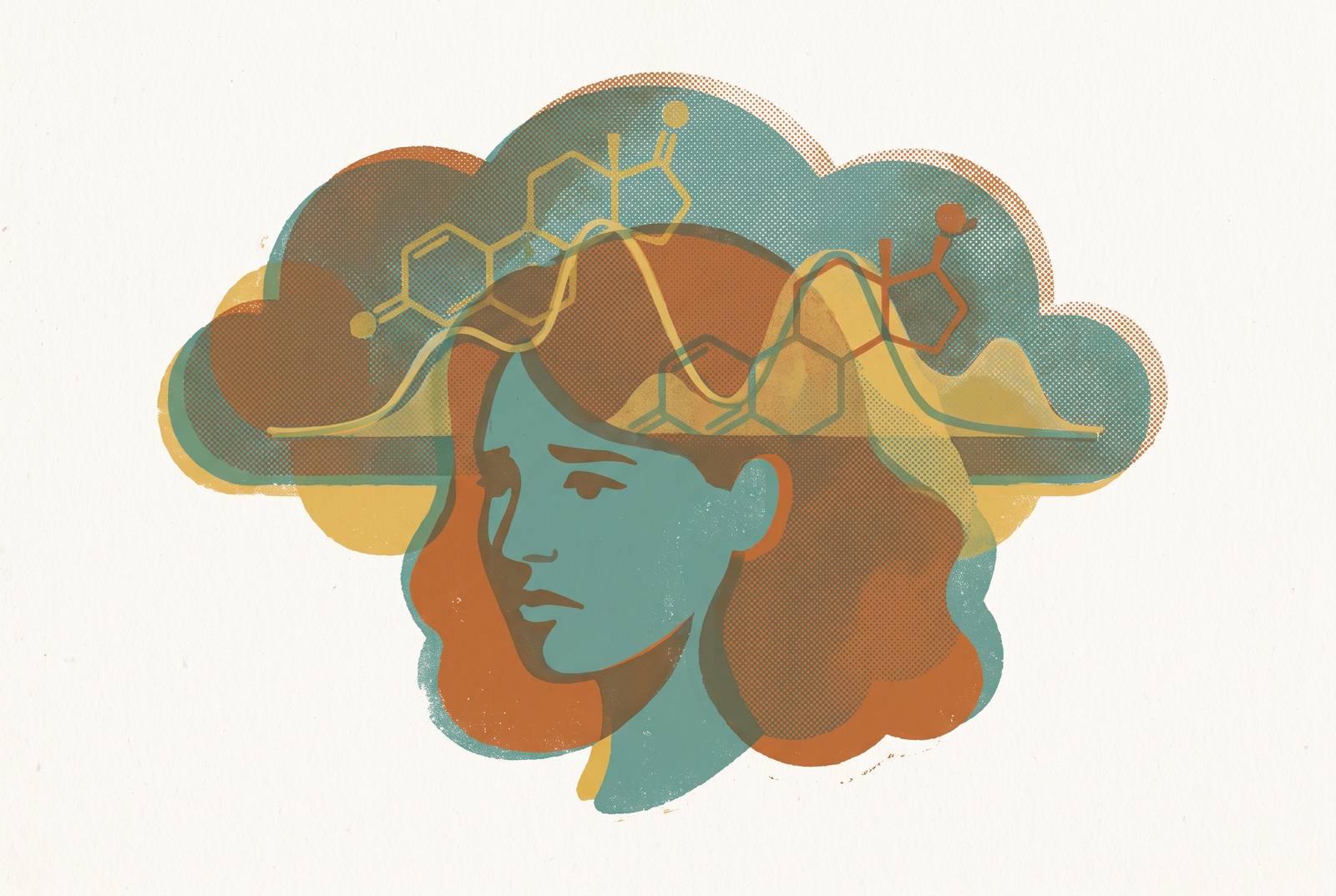
39% of women who sought care for perimenopause symptoms in a 2025 national survey came away feeling misdiagnosed. Most of those misdiagnoses had a specific shape: anxiety, depression, mood swings, panic attacks, treated as standalone psychiatric conditions rather than as symptoms of a hormonal transition. The gap between what was happening in these women's bodies and what their charts said was happening runs through nearly every part of the healthcare encounter, from the intake form to the lab order to the prescription pad. This piece traces that gap, mechanism by mechanism, and asks a fairly direct question: what would it take for a clinician to catch perimenopause before defaulting to a psychiatric label?
What perimenopause is and why its timeline makes it so easy to overlook
Perimenopause is the transition leading up to menopause, starting when the ovaries begin winding down their function. That usually happens sometime in a woman's 40s, though it can start as early as the mid-30s for some. The average length runs around four years, but the actual range is much wider, and a woman is technically still in perimenopause until she's gone a full twelve months without a period.
The staging system researchers use, known as STRAW+10, breaks the transition into recognized phases. Early menopause transition (Stage -2) is marked by cycle variability of seven or more days. Late menopause transition (Stage -1) begins once a woman has had a cycle stretch to 60 days or longer. Perimenopause as a whole extends through Stage +1a, which covers the twelve months following the final period. Why does the staging matter for diagnosis? Because a woman in early perimenopause might have no menstrual irregularity at all yet. The hormonal machinery is already shifting, but the marker most people (including many clinicians) associate with perimenopause, the irregular period, simply hasn't shown up.
Layer onto that timeline the fact that perimenopause is defined by instability rather than a steady downward slope. Symptoms can appear for a few weeks, fade, and come back looking completely different a month later. That inconsistency is not a sign that nothing's wrong. It's the actual signature of the condition. Researchers who've combed through symptom logs have catalogued a wide array of distinct symptoms tied to hormonal imbalance during this window, clustering loosely into categories like mood and cognition, digestive changes, and vasomotor symptoms (hot flashes, night sweats). A long, variable timeline with no single defining marker and a symptom list that sprawls across nearly every organ system: that combination is exactly what puts perimenopause into diagnostic no-man's-land.
Why estrogen behaves more like a destabilizing force than a simple decline during perimenopause
The phrase people reach for is "estrogen drops." That's not wrong, exactly, but it's incomplete in a way that matters clinically. As ovarian follicles get depleted, the pituitary gland ramps up secretion of follicle-stimulating hormone (FSH), trying to coax the ovaries into producing. That drive doesn't smooth things out, it destabilizes them. Estradiol levels can spike to multiples of a woman's normal premenopausal peak before crashing down again. Progesterone, meanwhile, declines more steadily but becomes erratic in its own right.
Research and related neuroscience literature have documented that day-to-day estradiol variability during perimenopause is both faster and larger in magnitude than the fluctuation seen during a normal premenopausal cycle. Higher peaks, lower troughs, and less predictability connecting the two.
The FSH feedback loop works like this. As the ovaries become less responsive to FSH and LH signaling, the body compensates by pushing FSH output higher still. So an elevated FSH reading on a blood panel isn't a direct measurement of low estrogen, it's a signal that the ovaries are struggling to respond at all. In early perimenopause specifically, women often show lower luteal-phase progesterone paired with rising FSH, which is what drives those irregular, heavier, or skipped periods well before any obvious estrogen decline shows up on paper. Then, roughly one to two years before menopause actually hits, the estradiol drop turns more sudden, and that's frequently when symptoms intensify the most.
A single hormone test can land on a high estradiol day and come back looking perfectly normal. That's one of the clearer arguments for tracking hormone levels over multiple points in time, rather than treating one blood draw as the final word.
How estrogen's role in brain chemistry turns hormonal swings into mood symptoms that look psychiatric
Estrogen isn't only a reproductive hormone. It plays a substantial role in regulating mood, cognition, and brain health generally, acting directly on the central nervous system. Specifically, it modulates serotonergic function by increasing expression of tryptophan hydroxylase, the rate-limiting enzyme in serotonin synthesis, and by regulating serotonin receptor subtypes, including 5-HT1A and 5-HT2A. Those are the same pathways most antidepressants are built to target. Estrogen also touches dopamine and norepinephrine metabolism, both central to motivation, focus, and how the body handles stress.
But how does this connect to the mood symptoms women describe? The instability itself, not just the eventual low level, appears to be the disruptive force. Erratic and extreme estradiol fluctuation destabilizes the neural circuits governing reward processing and emotion regulation, the same circuits implicated in major depressive disorder. Subcortical brain regions commonly tied to depression are dense with estradiol receptors and susceptible to structural change as estradiol regulates synaptic density in those areas.
Testosterone factors in too. It declines with age in women and may contribute to brain fog and low mood on its own. Some research has found that phases of perimenopause marked by a higher testosterone-to-estradiol ratio were linked to increased depressive symptoms. None of this is metaphorical. The neurochemical effects of perimenopausal hormone swings run through the same biological pathways as clinical depression, which is exactly why the resulting symptoms can be clinically indistinguishable from a primary psychiatric episode, absent more context.
What the research shows about depression risk during perimenopause, and why the timing is specific
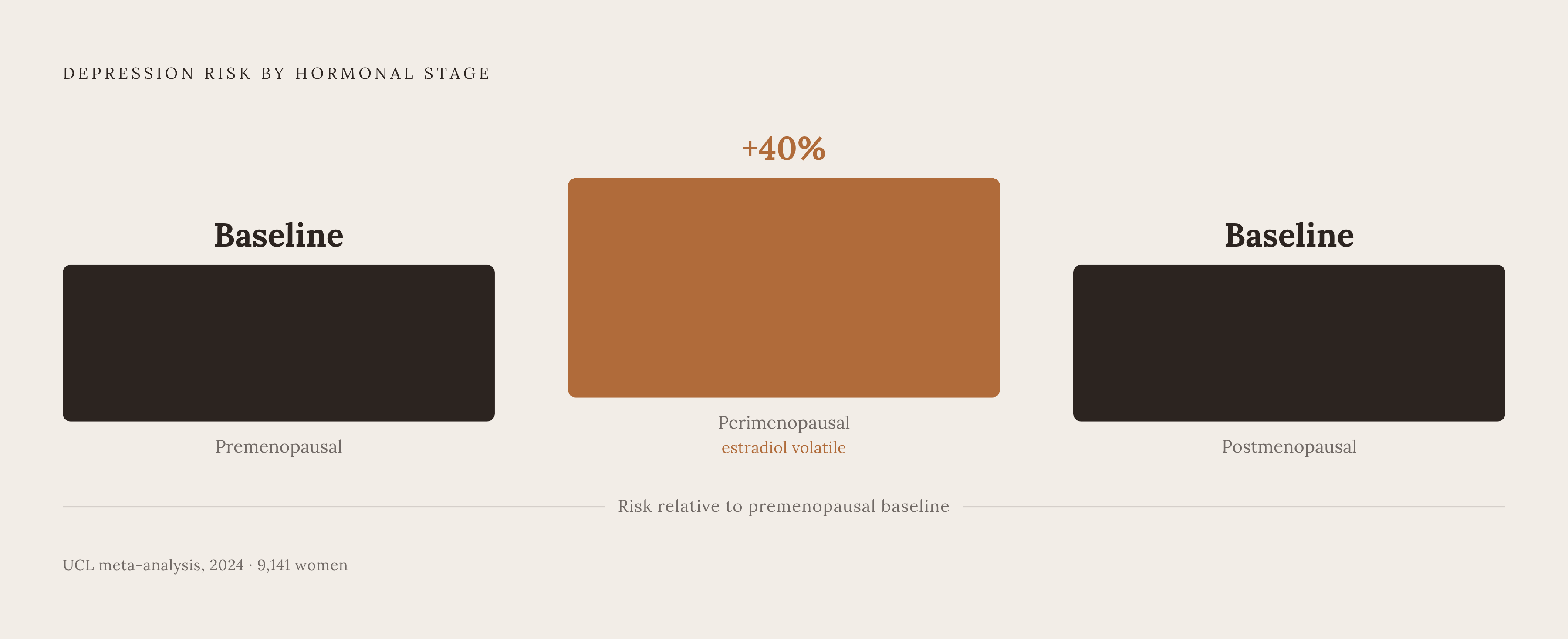
A 2024 meta-analysis in the Journal of Affective Disorders, led by researchers at UCL and pooling seven studies covering 9,141 women across the US, Australia, China, the Netherlands, and Switzerland, found that perimenopausal women face roughly a 40% higher likelihood of depression compared to premenopausal women. That number alone is notable. What's more telling is what the same study found for postmenopausal women: no significant increase in depression risk compared to the premenopausal baseline.
That timing detail deserves a moment of attention. If depression risk were simply about estrogen being low, postmenopausal women, who have consistently low estrogen, would show elevated risk too. But postmenopausal women, who have consistently low estrogen, do not show elevated risk. The risk clusters specifically in the transition, when hormone levels are swinging wildly rather than settled at a new baseline. That lines up with the volatility mechanism described above: it's the instability driving the psychiatric risk, not the destination point.
Additional research backs this up, finding that women in the menopause transition show substantial day-to-day estradiol variability alongside a markedly higher risk of major depression. And this risk isn't confined to women with a prior psychiatric history. Even women who've never experienced depression before face elevated risk during perimenopause, which suggests biology is doing real work here, not just amplifying existing vulnerability.
The symptom picture also tends to look a bit different from textbook major depressive disorder. Women often describe irritability, tearfulness, a loss of motivation, and a flatness that feels oddly disconnected from their actual life circumstances, rather than a clean, stimulus-linked sadness. That mismatch between the symptom and its apparent cause is exactly the kind of thing a standard diagnostic checklist isn't built to catch. In the Biote survey, 45% of women said perimenopause symptoms had negatively affected their emotional, social, or mental health, and 35% said they wished someone had told them perimenopause could touch mental health at all, not just hot flashes and sleep.
Why a standard clinical encounter is structured in ways that almost guarantee perimenopause gets missed
Start with who's asking the questions. In the Biote survey, only 42% of clinicians brought up perimenopause on their own. That means a majority of women walked into appointments holding questions nobody prompted them to ask. Among women who did manage to discuss perimenopause with a provider, 65% of those who came away unsatisfied felt their concerns weren't fully addressed. A meaningful share said their provider didn't take the concerns seriously at all, and 9% were simply redirected to someone else. More broadly, 37% of respondents said perimenopause never came up in conversation with their provider, period.
Then there's the trouble with screening tools themselves. The PHQ-8, a standard depression screening instrument, includes eight symptom categories, and seven of them, sleep disruption, appetite changes, fatigue, concentration trouble, mood disturbance, overlap directly with ordinary perimenopause symptoms. A clinician who runs the PHQ-8 without first asking about menstrual cycle changes or hormonal history is very likely to score a perimenopausal woman as depressed without ever ruling out the hormonal explanation. The tool wasn't built with this overlap in mind, and it shows.
Age compounds the issue. Among Millennial women (ages 30 to 44), 46% said their provider never proactively asked about perimenopause symptoms, compared to 29% of Gen X women (ages 45 to 60). Only 18% of Millennials got perimenopause information from a primary care provider or OB/GYN, versus 41% of Gen X women. Younger women in this transition are, structurally, less likely to be recognized at all, presumably because their age doesn't match the mental shortcut clinicians use.
And that shortcut runs deep: in roughly 75% of women who present within the "expected" age range, clinicians diagnose menopause-related changes without ordering any lab work. That's a reasonable enough heuristic in plenty of contexts. But when mood is the presenting complaint, skipping the hormone panel leaves the entire hormonal picture invisible. What's left is a woman with mood symptoms and standard labs that look unremarkable, which maps cleanly onto a depression or anxiety diagnosis and produces a prescription rather than a real workup.
What hormone testing involves and what it can and cannot show
A typical panel includes FSH, estradiol (E2), progesterone, and often LH and testosterone. TSH gets added frequently too, to rule out thyroid dysfunction, which produces its own overlapping set of fatigue and mood symptoms. FSH functions as an indirect signal: elevated levels mean the pituitary is working harder to stimulate ovaries that are becoming less responsive, marking the transition itself rather than confirming menopause has arrived.
Estradiol is trickier to read in isolation. Because levels swing so much across a single cycle and even day to day, a "normal" reading on any given draw doesn't rule out real hormonal instability happening elsewhere in that same month. Timing relative to the menstrual cycle changes what a given number even means: a luteal-phase reading tells a different story than a follicular-phase one, and mixing them up without noting the timing muddies interpretation considerably.
This is where taking only a single snapshot, mentioned earlier in relation to estradiol's volatility, becomes a testing design issue rather than just a biological curiosity. One blood draw might catch a high estradiol day and read as entirely unremarkable. Multiple draws spread across weeks or months, though, start to reveal the oscillation pattern itself, the actual peaks and troughs that the research ties to depression risk. A single data point can't show a pattern. Only a series can.
Raw numbers also need a clinician's eye. A lab report showing "normal" values isn't the same thing as a hormonally stable woman, particularly given how much day-to-day swing is normal during this transition. When mood symptoms appear alongside FSH elevation and estradiol volatility, the clinical story shifts: this looks like perimenopausal neurochemical disruption, not an idiopathic psychiatric condition. That distinction isn't academic. It changes which treatments even belong on the table.
How women can use what they now know to get a better clinical workup
Documentation first. Before any appointment, it helps to write down the mood changes (particularly irritability, low motivation, or tearfulness that feels out of proportion to circumstances), sleep disruption, any changes to cycle regularity or flow, brain fog, and fatigue. All of it, in writing, dated where possible.
From there, the ask can be specific: a hormone panel covering FSH, estradiol, progesterone, and LH, plus TSH to rule out thyroid involvement, with a note of where the patient is in her cycle at the time of the blood draw. If a provider reaches for a depression screening tool like the PHQ-8 without first asking about cycle changes or hormonal history, that's the moment to name the overlap out loud. Something like: this needs to rule out a hormonal cause before treating it as a psychiatric condition.
One might argue a single hormone panel is enough to settle the question. It isn't, and the research above explains why: a reading taken during a hormonal high can look completely normal, which is exactly the trap. Results gathered at multiple points across a few months paint a far more reliable picture, because they capture the pattern of instability that the current research ties to mood symptoms, rather than a single frozen moment that might not represent much of anything.
Only 26% of women currently get perimenopause information from a primary care provider or OB/GYN, per the Biote survey. Arriving at an appointment already informed and ready with specific requests isn't adversarial, it's compensating for a documented, measurable gap in how care gets delivered. And 35% of women in that same survey said they wished they'd known earlier that perimenopause could affect mental health at all. A reader who's made it this far already knows something that most women in that survey didn't going into their own appointments, and that knowledge, on its own, functions as a clinical tool. Direct-to-consumer hormone testing, when it includes review by an actual clinician, gives women a way to start building that hormonal picture outside the constraints of a single rushed appointment, and to walk into any future conversation with data in hand rather than just a list of symptoms and a hope that someone finally asks the right question.