Reading Your Own Hormone Results When No Referral Is Coming
Learn how to interpret hormone levels when perimenopause testing goes unexplained.
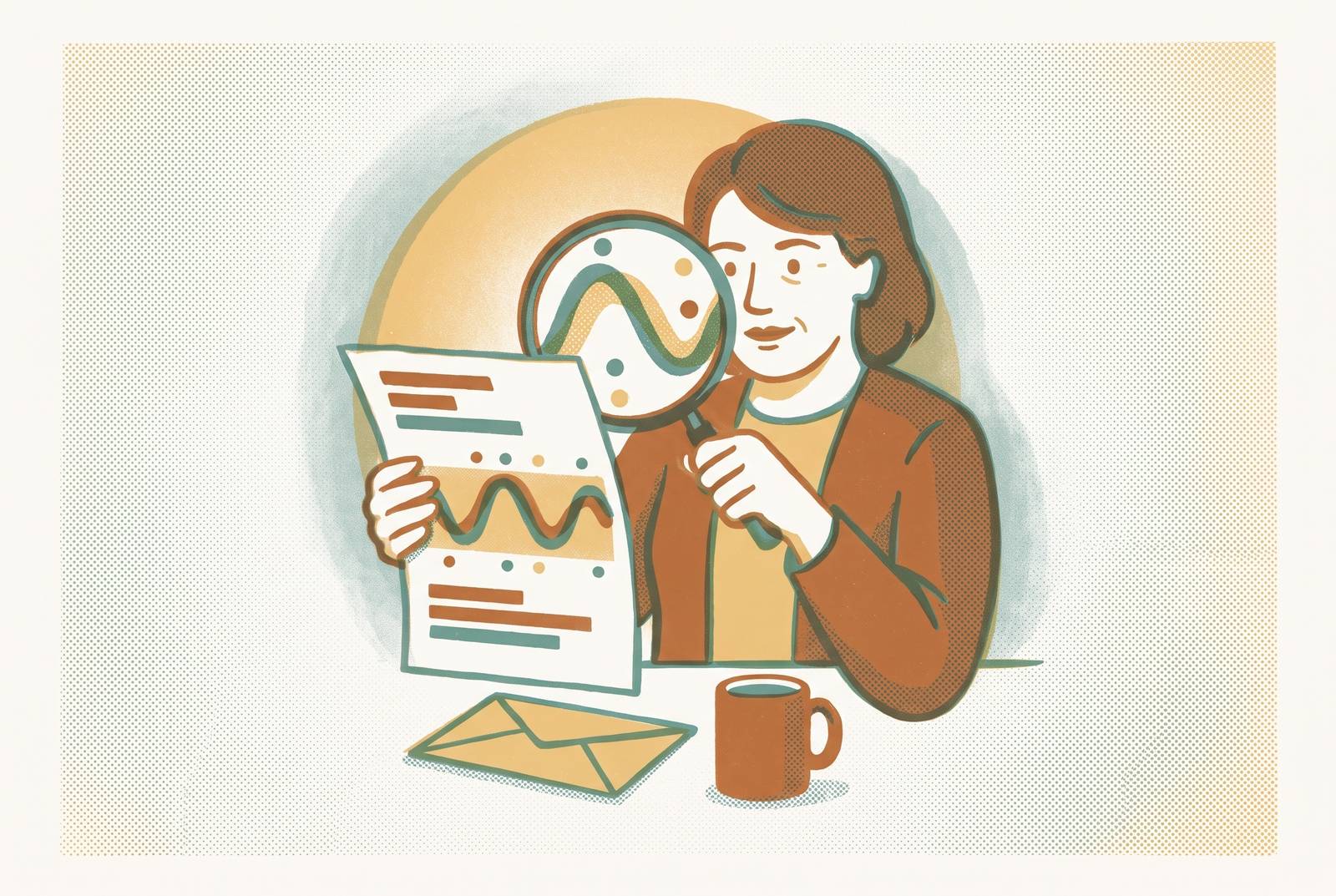
Perimenopause testing without a doctor's referral is useful only when results are read in context. Women who already have results can make meaningful sense of them by understanding each marker, the timing of the blood draw, and changes across months. Knowing how to read the results helps you seek the care you need, but a clinician still needs to review them.
Why hormone results are hard to read during perimenopause — and why that is a system problem, not a personal failing
The results are in your hand, but no callback is scheduled. Some numbers are within the laboratory's reference ranges, even though your sleep, periods, or temperature regulation have changed. What are you supposed to conclude from that mismatch? Without an explanation of what the tests measure, the report asks you to make a clinical distinction that its layout cannot supply. The confusion is built into the handoff.
That gap sits within a wider pattern of dismissal. Kesha Klaw, 44, had hot flashes, insomnia, and weight gain attributed to work-related stress by her primary care physician, who told her she was too young for perimenopause. A women's health specialist later confirmed she was in perimenopause. For women who do receive testing, a similar gap opens when a result is labelled normal without explaining whether it can answer the question being asked.
Why perimenopause hormone levels do not behave the way most lab reference ranges imply
A reference range can look like a boundary between healthy and unhealthy. During perimenopause, that reading is too simple because the defining feature is hormonal volatility. Estradiol can surge before it falls, and temporary increases can occur even late in the transition. A result inside the range can therefore be clinically relevant, while one outside it may fit the transition. The range is not a destination.
ACOG, NICE, and The Menopause Society state that routine hormone testing is not required to diagnose perimenopause in women over 45 with typical symptoms. That guidance reflects the limits of a snapshot, rather than a claim that hormone measurements have no value. Why test if the numbers can move so widely? Repeated, appropriately timed measurements can reveal a direction of change, providing context for interpretation.
What FSH is actually measuring — and why a normal result does not rule perimenopause out
Follicle-stimulating hormone, or FSH, measures part of the signalling between the brain and the ovaries. As the ovaries produce less estradiol, the anterior pituitary releases more FSH to stimulate follicle development. Put plainly, the brain is sending more signal because the ovaries are responding less. This is a negative-feedback loop. When estradiol falls, the restraint on FSH release weakens.
In early perimenopause, estradiol can be elevated, and that higher level suppresses FSH even while cycles are changing. A normal FSH result is therefore compatible with perimenopause. It describes the signal at that moment. Interpreting it without estradiol risks mistaking a temporary response for evidence against the transition.
Timing adds another layer to that relationship. For women who are still cycling, FSH is most informative when drawn on cycle days 2–5. A mid-cycle or luteal-phase draw will read differently and may mislead if treated as an equivalent measurement. Across months, a substantial upward trend is more informative than an isolated value. But to compare them, the timing of each sample needs to be known.
What estradiol results reveal — and why a high reading is not reassuring in the way it appears to be
If higher estradiol can suppress FSH, does the estradiol result itself offer reassurance? A high reading may reflect the erratic surging that precedes eventual decline. The Swiss Perimenopause Study documents highly individual estradiol fluctuations during this transition. One result cannot establish their direction. A single high reading is not reassuring on its own, just as a single low reading is not diagnostic.
Those fluctuations also help explain inconsistent symptoms. A week of intense hot flashes followed by a calmer week can fit a changing hormonal pattern. Being sensitive to rises, falls, or changes in estradiol may also help explain changes in mood. A symptom diary gives the laboratory record context. It makes it possible to ask whether a difficult interval coincided with a hormonal change, without assuming that every symptom has one cause.
As with FSH, estradiol is most informative on cycle days 2–5. A mid-cycle sample may catch the ovulatory surge, which is not a perimenopause-specific finding. Over the longer term, declining estradiol also has consequences for bone density and genitourinary health. Yet neither estradiol nor FSH confirms whether ovulation actually occurred. Progesterone addresses that separate question.
What progesterone actually tells you that FSH and estradiol cannot
Anovulatory cycles, in which periods continue and progesterone stays low, become increasingly common during perimenopause. This gives progesterone a more specific interpretive role than FSH or estradiol. A result above 3 ng/mL confirms that ovulation occurred in that cycle. A result below that cutoff, from a sample taken at the right time, suggests an anovulatory cycle even if the period seemed regular.
The timing rule is essential to that conclusion. Progesterone should be drawn approximately 7 days after ovulation, with the calendar day determined by ovulation timing. “Day 21” assumes a textbook 28-day cycle, an assumption that becomes especially unhelpful when cycles shift. A sample taken at the wrong point cannot establish whether ovulation occurred. Correctly timed, however, progesterone is the most directly interpretable number on the panel, adding information that a normal FSH and high estradiol cannot provide.
Where AMH fits — and what it can and cannot tell you about where you are in the transition
AMH reflects ovarian reserve. Unlike FSH and estradiol, it does not swing significantly across a cycle, so it can be drawn on any day. Its relative stability answers a different question. AMH declines with age and becomes undetectable at menopause, making it complementary to markers of current hormonal activity.
Longitudinal studies suggest that changes in AMH can help predict the timing of menopause within a roughly four-year window. That is potentially useful for planning. The practical obstacle is assay sensitivity, especially at low AMH levels. The ultrasensitive assays needed to make those low readings useful are not yet standard, so their use in day-to-day care is limited.
Confirmation of ovulation and tracking the symptom fluctuations that make one month feel worse than another fall outside AMH's interpretive scope. A reserve indicator is not a symptom map.
Why thyroid results belong on the same panel, not a separate conversation
A hormonal explanation does not have to be an either-or choice. Perimenopause and thyroid dysfunction can both produce fatigue, mood changes, brain fog, sleep disruption, weight changes, and temperature sensitivity. They can also occur together. Hashimoto's thyroiditis can be particularly difficult to distinguish from perimenopause because their symptom profiles overlap so closely. Finding evidence of one does not exclude the other.
A 2022 study in Thyroid covering more than 53,000 women found that overt hypothyroidism was substantially more prevalent in late perimenopause and postmenopause than in premenopause. Hot flashes, night sweats, and waking soaked point toward perimenopause, while thyroid dysfunction tends to develop gradually in one direction. Those patterns still need clinical interpretation.
For that reason, TSH belongs in the same diagnostic conversation as FSH and estradiol. It is the standard thyroid screening test and helps distinguish overlapping explanations. The practical implication is straightforward. Significant fatigue, cognitive symptoms, or weight changes call for thyroid testing even when there are already clear signs of perimenopause.
How to read results over time rather than as a single event
Once the markers' separate roles are clear, the unit of interpretation changes from a result to a trajectory. Consider an FSH level that moves substantially upward over a few months. The later number on its own cannot show how much it has changed. With a baseline, however, the change becomes visible as a pattern consistent with progression through perimenopause. The dates and the point in the cycle help show whether the results can be compared.
A record of intensified hot flashes or mood disruption can be read against the hormonal record. The Swiss study's findings on individual fluctuations support this longer view. They also caution against expecting every woman to follow the same sequence or every symptom to match a particular result.
In practice, the lesson is to retain the circumstances of each draw alongside the number. Cycle day and a symptom diary help distinguish a change across months from a difference caused by sampling at another point in the cycle. Serial testing provides a better basis for discussing uncertainty with a clinician and deciding what further assessment is appropriate.
What the STRAW+10 staging framework tells you about where your results fit in the larger arc
STRAW+10 maps the stages based on menstrual patterns, and hormone results are read as part of that wider pattern. In the late reproductive stage, periods may begin shifting slightly in timing while FSH creeps upward and AMH declines. Sleep may be disrupted now and then, or a hot flash may occur. These subtle changes are not the same as meeting a transition-stage criterion.
Early perimenopause is marked by cycles varying by seven or more days from the usual pattern. At this stage, FSH may still read normal, estradiol may be elevated, and progesterone becomes more variable as anovulatory cycles increase. Symptoms can feel confusingly inconsistent.
Late perimenopause begins with a gap of 60 days or more between periods. Estradiol is then trending downward and FSH is clearly elevated, although individual snapshots still need context. Symptoms often peak during this stage. Hot flashes and night sweats may happen more often, along with more disrupted sleep and intense mood or anxiety symptoms.
Xiangrong Liu and colleagues' 2025 study in Arch Gynecol Obstet found anxiety symptoms in a majority and depressive symptoms in 68.7% of perimenopausal participants. Those findings show why mood belongs in the assessment. The endpoint has a clearer rule. Perimenopause ends after 12 consecutive months without a period.
How to use results to advocate for yourself when the clinical conversation stalls
To turn this knowledge into self-advocacy, the useful move is from a broad concern to a specific question. What was the reason for drawing FSH or estradiol mid-cycle given the days 2–5 timing window? Would retesting in 8–12 weeks help establish the FSH trend? Was progesterone sampled approximately 7 days after ovulation? Each question identifies a limit in what an existing result can establish, rather than demanding that a number prove a diagnosis.
Asking whether TSH has been included keeps thyroid overlap open for consideration. Referring to cycle variation of seven or more days gives a clinician a STRAW+10 criterion to assess. Specificity changes the basis of the discussion. Instead of debating whether symptoms “sound hormonal,” the conversation can address timing, menstrual patterns, competing explanations, and evidence.
Clinician review remains essential, particularly because apparently reassuring results can coexist with symptoms that deserve care. You can understand the tests without having to diagnose yourself or use a laboratory value to justify every symptom. It gives you a firmer basis for requesting an explanation, a review, or further assessment. The strongest position is not certainty about a number, but clarity about what it can answer and what remains unresolved.
Sources
- Investigation of the quality of life and influencing factors among perimenopausal women
- Steroid Hormone Secretion Over the Course of the Perimenopause: Findings From the Swiss Perimenopause Study
- Follicle-stimulating hormone: More than a marker for menopause FSH as a frontier for women’s mental health - PMC