The Full Map of Conditions Doctors Reach for Before Perimenopause
Why doctors often miss perimenopause by chasing other diagnoses first.
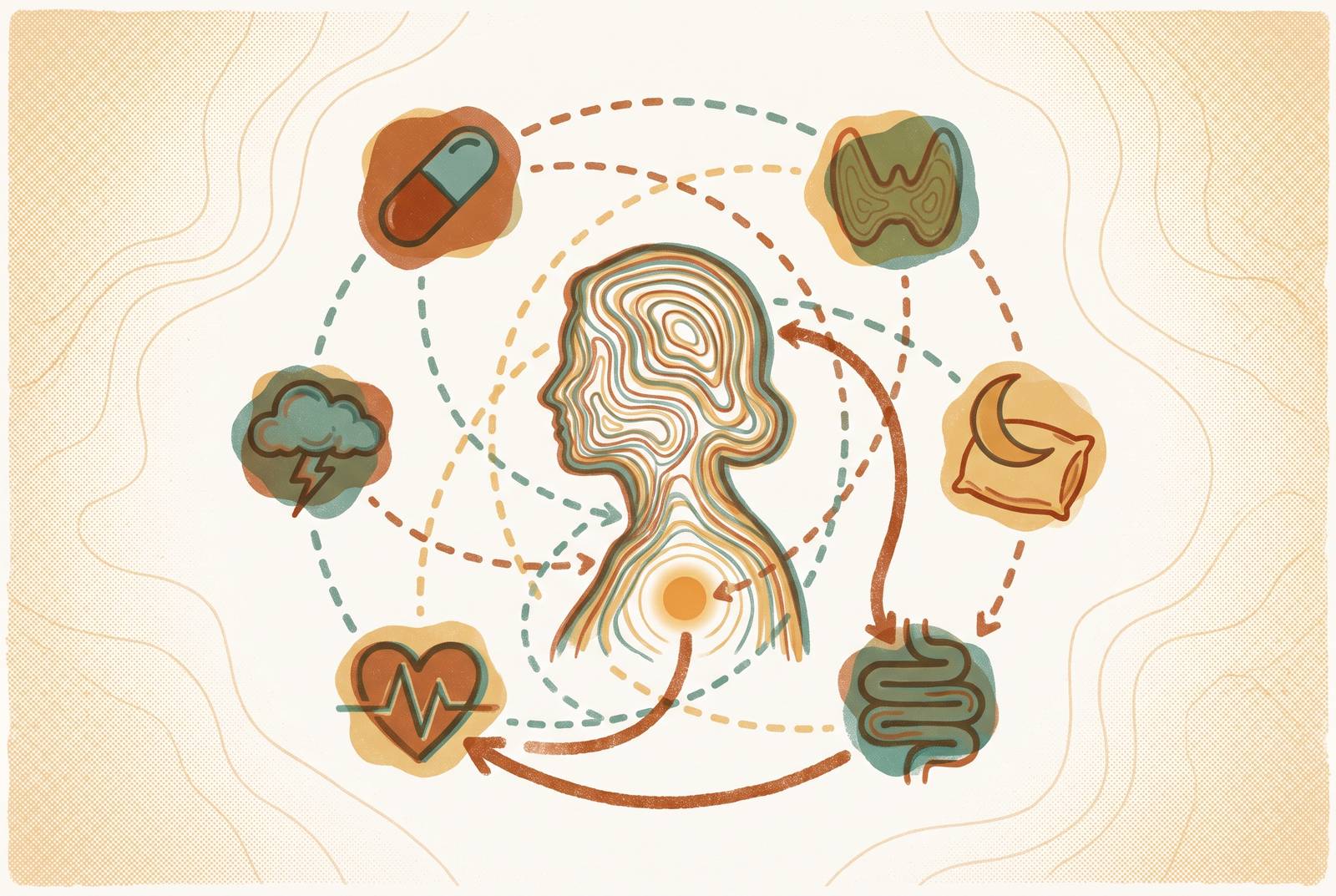
Perimenopause symptoms are commonly mistaken for anxiety, depression, thyroid dysfunction, joint disease, sleep disorders, and stress-related burnout because these conditions overlap and no single blood test confirms the transition. Knowing how these diagnoses overlap helps women see when their symptoms have been brushed aside and ask for a closer look. The aim is not to replace every diagnosis with perimenopause, but to consider hormonal change without overlooking other causes.
Why perimenopause sits at the end of a long diagnostic queue
The diagnostic queue begins with a structural gap. Clinicians have no single confirmatory test, while the framework used to stage reproductive aging emphasizes changes that may not capture the earliest symptoms. The STRAW+10 staging framework focuses on menstrual cycle changes and follicle-stimulating hormone, or FSH, patterns. Yet FSH can remain within a normal range through much of perimenopause, leaving a gap between a woman’s experience and the signs that make the transition easier to classify.
That gap becomes harder to navigate when clinicians do not introduce the possibility of hormonal change. The Biote national survey found that only 42% of patients had their primary care provider or ob-gyn initiate discussions about perimenopause symptoms. The conversation often starts somewhere else as a result. A system better equipped to identify individual conditions than a fluctuating transition can leave perimenopause until late in the investigation, even when alternative diagnoses receive careful consideration.
Anxiety and panic: the most common first stop on the misdiagnosis route
Anxiety is often the first diagnosis because the early psychological symptoms look like those clinicians know from anxiety. Sudden panic sensations, feeling overwhelmed more easily, loss of confidence, and increased sensitivity can all appear during perimenopause. An anxiety label may simply describe how these symptoms feel without explaining their origin.
As progesterone declines, its associated neurosteroid allopregnanolone also falls, weakening the GABAergic inhibitory system involved in calming neural activity. Estrogen also helps regulate cortisol, so fluctuating estrogen can contribute to a pattern of anxiety, fatigue, insomnia, and weight gain. These symptoms can resemble generalized anxiety disorder. Treatment directed at anxiety may therefore leave a hormonal contributor unaddressed, although that does not make mental health care inappropriate or establish that standard treatment cannot help.
Ying Zhang and colleagues’ 2025 study in BMC Women’s Health examined anxiety burden among perimenopausal women using data from 1990 to 2021. The study found a rising age-standardized disability burden and projected a 40.67% increase from 2021 to 2035. Although it does not measure misdiagnosis, the study shows why distinguishing anxiety symptoms from their possible drivers deserves attention beyond the first psychiatric label.
Depression: a real co-occurrence that can obscure a hormonal cause
Depression complicates the map because it can genuinely co-occur with perimenopause. Women in this transition have an elevated risk of depression, and hormonal change belongs in the explanation of that risk. Mood swings, irritability, persistent low mood, and emotional dysregulation can also resemble a depressive episode. These are not mutually exclusive clinical possibilities.
Partial treatment relief can make that distinction harder to see. Some antidepressants affect sleep and thermoregulation, so improvement does not by itself establish that depression explains every symptom. The Biote survey found that nearly 40% of women seeking care for perimenopause symptoms reported feeling misdiagnosed. That finding tells how patients felt, without a separate check that each diagnosis was wrong. It nevertheless raises an important question about whether the hormonal explanation received a hearing.
The clinical implication is to investigate hormonal change while treating mood symptoms, rather than requiring one explanation to defeat the other. Relief is valuable in its own right. But when it is incomplete, it should not automatically close the inquiry into what prompted the symptoms.
Thyroid dysfunction: the shadow diagnosis that runs in both directions
Thyroid disease brings the search beyond psychiatric causes to another condition in the body that can cause the same symptoms. A professional society’s 2024 position statement in Maturitas identifies shared features including menstrual irregularities, mood disorders, increased sweating, sleep disturbances, and hair loss. The overlap makes thyroid testing clinically useful. It also makes a symptom checklist alone a poor way to distinguish the conditions.
The confusion can run in either direction. Thyroid symptoms may be attributed to perimenopause, while symptoms of the transition may be attributed to thyroid dysfunction. Both conditions can also be present. The position statement calls for greater awareness of co-existing thyroid disease rather than treating the two explanations as alternatives that cannot coexist.
A normal thyroid result therefore indicates normal thyroid function while leaving other hormonal causes open. Likewise, treatment for thyroid disease does not establish that all remaining symptoms have the same cause. The Doctors Practice checks thyroid function in its perimenopause workup because it needs to look for problems that may be present at the same time. The useful distinction is between testing an alternative explanation and using that test to exclude something it does not measure.
Joint pain, arthritis, and Lyme disease: when the body becomes the focus
Joint pain can lead clinicians to look for arthritis, age-related degeneration, or infection before they discuss hormonal change. Stiffness and muscle weakness add to that focus on the body. Yet these symptoms can also appear during early perimenopause, and falling estrogen can increase inflammation and make existing wear and tear more painful.
This is why musculoskeletal complaints can create another diagnostic detour. When joint pain is attributed entirely to developing arthritis or Lyme disease, perimenopause treatment may be delayed. Either diagnosis should be considered alongside investigation of the wider symptom pattern, even when it offers a plausible explanation for pain.
The longer consequence extends beyond discomfort alone. Estrogen decline also accelerates bone loss, with rapid loss occurring around the final menstrual period. Joint pain alone does not show bone loss, but missing the transition can mean losing the chance to care for bone health early. That makes the hormonal context relevant even when the appointment begins with a painful joint.
Sleep disorders, chronic fatigue, and burnout: the catch-all category
It is especially easy to explain sleep disruption and fatigue through what is happening in a woman’s life at midlife. Work demands, caregiving, and relationship stress offer socially familiar accounts of why a woman feels depleted. They may also be genuine pressures. The blind spot appears when their plausibility makes further investigation seem unnecessary.
Difficulty falling asleep, middle-of-the-night waking, and waking unrefreshed can accompany hormonal shifts. Yet the same experiences may attract labels such as insomnia, chronic fatigue, or stress-related burnout, particularly when schedules are overloaded. What separates a reasonable explanation from a premature conclusion? Often, it is whether the clinician considers the timing and clustering of symptoms rather than assuming that a demanding life explains them.
There are also legitimate physical alternatives to investigate. Deficiencies involving B12, vitamin D, iron, or magnesium can contribute to fatigue and cognitive symptoms, while thyroid dysfunction, depression, and anxiety add further overlap. Without a detailed history, a deficiency or a stress explanation can become another stopping point, even when hormonal change remains relevant to the symptoms that persist.
Lupus, fibromyalgia, and other systemic conditions that enter the differential
Lupus and fibromyalgia appropriately enter the differential because their symptom profiles overlap with perimenopause. Investigating them is not the diagnostic error. Delaying hormonal assessment until every other possibility has been exhausted prevents concurrent consideration of these explanations.
Yvette Pyne and colleagues’ 2024 WHO Bulletin analysis describes substantial variation between populations in cognitive symptoms, mood changes, sleep disturbances, urogenital symptoms, and muscle and joint pain 1. There is no universal symptom cluster. With symptoms that vary so much, perimenopause can be hard to recognize even after several appointments. A concurrent approach keeps it among the leading possibilities without weakening the investigation of systemic disease.
The traffic also runs the other way: when perimenopause absorbs something serious
The same reasoning error can also make perimenopause an overly convenient answer. If night sweats, tiredness, or another persistent symptom is called hormonal without adequate investigation, the label can obscure serious illness. Familiarity is not proof of the cause. Symptoms associated with the transition can also occur for entirely different reasons.
Toonkel’s account describes persistent itching attributed to hormonal change over two years and encounters with 11 doctors before a cancer diagnosis. Documented cases have also involved night sweats and tiredness as early signs of blood cancer. These examples show why symptoms alone cannot establish their cause and why assuming hormones are the cause can be unsafe.
Perimenopause needs support from a clinical history and a pattern over time, even in the absence of an obvious alternative. That investigation should also leave room for other causes. Making perimenopause visible in clinical care is not the same as giving it permission to explain everything.
Why a single normal blood test keeps women stuck in the queue
“Your blood tests are normal” can sound like a definitive answer when it is only a result from one moment. During perimenopause, FSH, luteinizing hormone, or LH, and estradiol can fluctuate substantially. A sample can be within the normal reproductive range even when symptoms are severe. Even an accurate, useful measurement has limits when used to rule out a changing process.
Timing also affects the interpretation of progesterone. Progesterone can fall before estrogen declines significantly, and assessment depends on the phase of the menstrual cycle. The mid-luteal phase is approximately day 21 in a 28-day cycle, with testing dates dependent on each woman’s cycle. Without knowing when the sample was taken, the result may leave the question it was meant to answer open. This is why asking when a sample was taken can be as relevant as asking whether it was marked normal.
STRAW+10 defines the early menopausal transition through persistent cycle-length variability of seven or more days, which cannot be established from a single blood draw. NICE and the European Society of Endocrinology state that women over 45 with typical symptoms do not require laboratory testing for diagnosis. Clinical history and symptom pattern can be sufficient.
A normal result should therefore not end the conversation. Nor should isolated FSH, LH, or estradiol levels be used to conclude that ovulation has stopped, because it may still occur during perimenopause. The practical distinction is between what a laboratory measurement shows and what the wider clinical record can establish.
What the pattern looks like from inside it, and how to name it to a clinician
Anxiety is treated, sleep is still disrupted, joint pain is given another explanation, and blood tests seem to leave things unresolved. The connecting information is the pattern across these encounters. Symptoms spanning psychological, physical, and cognitive domains, partial relief from individual treatments, normal test results, and onset in the late 30s to mid-40s together warrant consideration of perimenopause.
Regular cycles do not disqualify that possibility. Early hormonal changes and vasomotor symptoms can precede menstrual irregularity, so a woman need not wait for conspicuous cycle disruption before raising the question. This is where the map becomes useful at an appointment. It helps turn a collection of complaints into a history that a clinician can assess as a whole.
For a woman recognizing this pattern, the practical step is to build a longitudinal record. Tracking cycle lengths over ten or more cycles, noting symptoms that appear together, and recording when they occur can make the timeline clearer. That record supplies information that a one-symptom-at-a-time consultation or an isolated test can miss.
The conversation can then address whether perimenopause has been considered given age, symptom clusters, and treatment history. Asking whether a mid-luteal hormonal assessment would be appropriate can clarify the purpose and timing of any proposed testing. Asking to go through the symptom history in detail can also bring the discussion beyond the latest complaint. Perimenopause is a clinical diagnosis, so abnormal laboratory results are not an admission ticket to that conversation.
Sources
- The Silent Symptoms Of Perimenopause: Why So Many Women Are Misdiagnosed
- Towards a more accurate global picture of perimenopause
- Global, regional, and national burden of anxiety disorders during the perimenopause (1990–2021) and projections to 2035
- Maturitas 185 (2024) 107991 Available online 24 April 2024