Estrogen Withdrawal and Night Sweats Mechanism
Estrogen withdrawal destabilizes temperature regulation, not simply depletes the hormone.
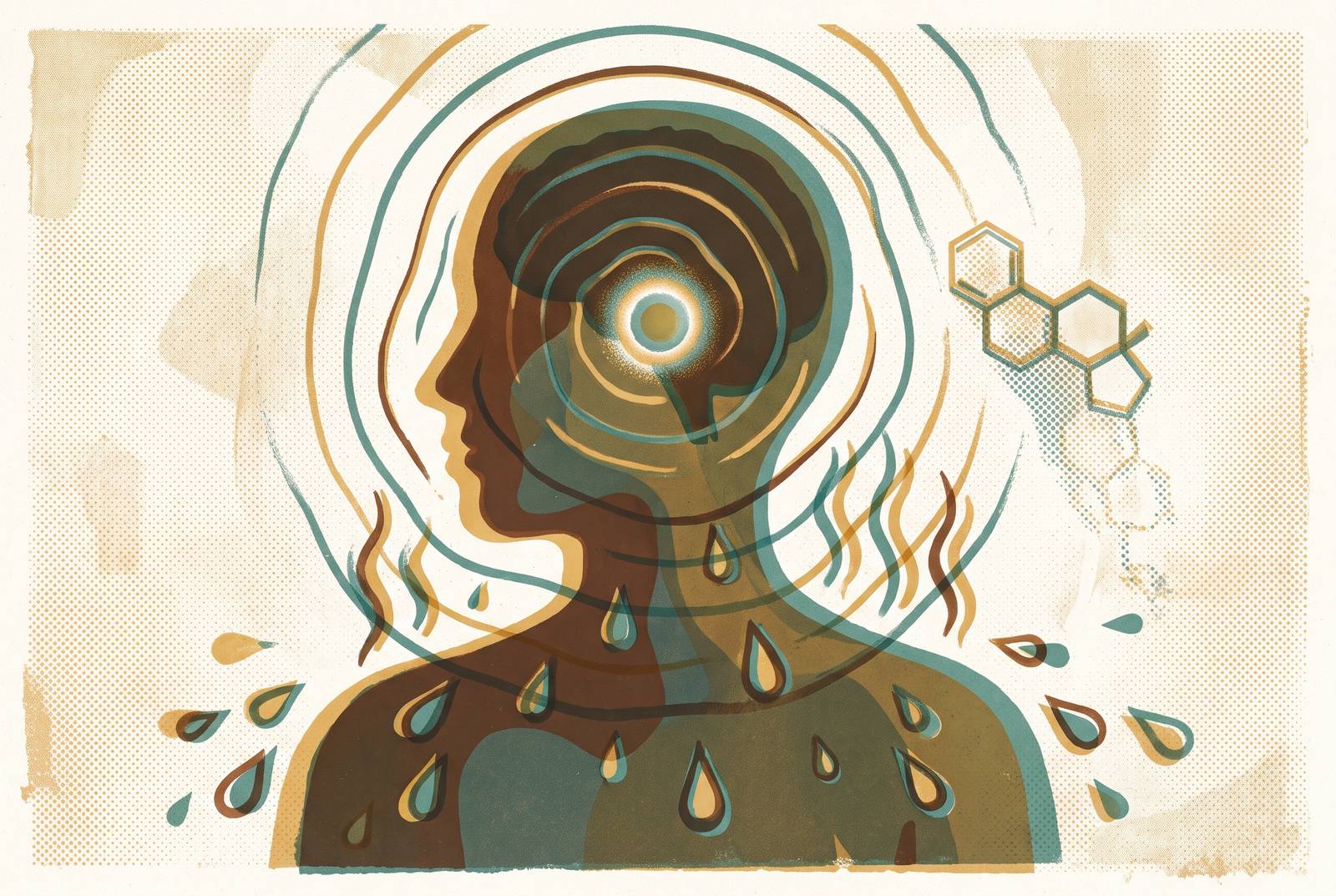
Night sweats during perimenopause are not simply a sign that estrogen is low. They arise when estrogen withdrawal destabilizes a neural circuit that regulates body temperature, triggering an exaggerated cooling response during sleep. Understanding that mechanism explains why symptoms can begin before periods stop, why a normal hormone result cannot dismiss them, and why treatment can target more than the sweating itself.
Why night sweats during perimenopause are not simply a symptom of low estrogen
Waking drenched at 3 a.m., repeatedly, for months or years deserves a better explanation than “your estrogen is low.” That phrase identifies a hormone involved, but leaves the crucial biological steps unexplained. Why does a change in reproductive hormones cause the body to sweat during sleep? Estrogen withdrawal can make it harder for the brain to handle small temperature changes without setting off a full cooling response.
The distinction has a direct clinical consequence. Estrogen levels do not reliably differ between women who have vasomotor symptoms, including hot flashes and night sweats, and women who do not. The clinical distinction depends on what happens to the temperature buffer that estrogen helps maintain.
How the hypothalamus normally maintains the body's temperature buffer
The hypothalamus regulates temperature within a window known as the thermoneutral zone. Within that window, the body can tolerate temperature variation without activating a substantial cooling or warming response. A small change does not have to become an emergency, much as a well-calibrated thermostat does not switch on cooling at every minor fluctuation.
Estrogen is one of the inputs that maintains this calibration during the reproductive years. It acts on the hypothalamic preoptic area, which coordinates the pathways responsible for losing heat. When temperature crosses the upper boundary of the tolerated range, sweating, vasodilation and an accelerated heart rate can activate. Vasodilation is the widening of blood vessels involved in that heat-loss response. These are useful responses when cooling is needed. The problem begins when the threshold for activating them becomes too easy to cross.
The neural circuit that fails when estrogen withdraws — KNDy neurons and the false overheating alarm
Which part of this system loses its stability? The mechanism centres on neurons in the hypothalamic arcuate nucleus that project to the preoptic area. These cells co-express kisspeptin, neurokinin B and dynorphin, giving them the name KNDy neurons. During the reproductive years, estrogen acts as a brake on their activity, keeping their signalling within a range that does not unnecessarily trigger heat dissipation.
When estrogen withdraws, that brake weakens and KNDy activity becomes dysregulated. Neurokinin B signalling is a key part of this pathway. With the thermoregulatory system destabilized, an ordinary temperature signal can provoke a response out of proportion to the body’s actual need to cool. Flushing, sweating and a racing pulse are physiological events, even when no genuine overheating emergency has occurred.
During sleep, that exaggerated heat-loss response becomes a night sweat. This resolves an apparent contradiction in the experience. A woman can be drenched without having been dangerously hot, because the failure lies in the circuit’s calibration. A false overheating alarm explains why the body responds so forcefully to a signal that would previously have stayed within its tolerated range.
Why perimenopause — not menopause — is when thermoregulatory instability often begins
The brake can become unreliable when estrogen fluctuates and withdraws unpredictably, removing the stabilizing signal on which the hypothalamus depends. This loss of stability begins during perimenopause, sometimes years before periods stop. Continued menstruation does not rule it out. A woman in her early-to-mid forties who still has periods can already be experiencing this disruption.
In early perimenopause, some cycles may bring estrogen levels higher than those seen during the reproductive years, followed by steep drops. Progesterone declines earlier because its production depends on ovulation, which becomes inconsistent. The STRAW+10 staging framework identifies Stage -2, early perimenopause, with the beginning of irregular cycles and erratic hormonal patterns. Stage -1, late perimenopause, is marked by extended absent periods and is typically when vasomotor symptoms become prominent.
Those stages describe a transition. Hormonal input to temperature regulation can become unstable while periods continue. Describing night sweats only as a “menopause symptom” can obscure that earlier process. It also helps explain why an apparently high estrogen result does not necessarily contradict a perimenopausal pattern.
How long the thermoregulatory disruption lasts and what makes it worse
Vasomotor symptoms can persist for years, and women whose symptoms begin earliest in perimenopause tend to experience them longest. The CeMCOR progesterone trial protocol cites a cohort study that began earlier in the transition and found that symptoms among those with the earliest onset may continue for over twelve years. This is not a forecast for every woman.
A narrowed thermoneutral zone also changes how the body responds to its surroundings. When that buffer approaches zero, a warm room or summer night that was previously tolerable may push the system across its cooling threshold. External heat compounds an existing vulnerability. A 2020 study in the journal Menopause tracked symptoms across the calendar year and found that hot flashes and night sweats peaked in summer, with the night-sweat peak falling in June.
Other amplifiers include alcohol, caffeine, spicy foods, stress and smoking. These factors interact with a system that has already lost much of its usual tolerance. They are not interchangeable with the underlying estrogen-withdrawal mechanism, nor do they explain every episode. Rather, they help account for why symptom intensity can change even while the broader hormonal transition continues.
Why a single hormone panel cannot predict who will have severe night sweats
If hormones are involved, why can a panel look normal? A blood test captures a concentration at one moment, while the proposed mechanism involves changing hormonal input and the brain’s response to it. Those are different kinds of information. A one-time estrogen or FSH result cannot reliably predict how severe vasomotor symptoms will become or how long they will last.
Estradiol varies severalfold within a normal menstrual cycle and swings most widely in late perimenopause. In early perimenopause, FSH may rise while estradiol remains normal or elevated, because the ovaries increase estrogen output in response to the stronger FSH signal. That result can appear reassuring even while thermoregulatory instability is underway. The number is not necessarily wrong, but the conclusion drawn from it may be too broad.
The NHS, Mayo Clinic and Cleveland Clinic advise that women over 45 with typical symptoms do not need hormone testing for diagnosis. No single test establishes perimenopause or reliably measures its symptom burden. This is not an argument against all testing. When hormone measurements are collected over time, they can reveal fluctuations that a snapshot misses, although they still require clinical interpretation.
Night sweats that are not perimenopause — the conditions most likely to be confused
A known perimenopausal mechanism does not make every night sweat perimenopausal. Other disruptions can produce nocturnal sweating, so the explanation needs to fit the wider clinical picture. Both hypothyroidism and hyperthyroidism share features with perimenopause, including menstrual irregularities, mood changes, sleep disturbance and sweating. The European Menopause and Andropause Society’s 2024 position statement advised practitioners to maintain a low threshold of suspicion for thyroid disease when menopause-like symptoms appear.
Perimenopause classically produces drifting variability, with cycles shortening, skipping and stretching, whereas thyroid dysfunction more often produces a consistent change in flow or frequency that persists across cycles. That distinction can help frame a clinician’s questions. It cannot establish the cause on its own.
Anxiety disorders and certain medications, including antidepressants, diabetes medications and asthma inhalers, can also produce night sweats. Vitamin B12 deficiency affecting central nervous system temperature regulation is another possible explanation. Certain cancers, including lymphoma, are serious possible causes that clinicians must consider and assess urgently if they suspect them. These alternatives explain why understanding the perimenopausal mechanism should support a diagnostic conversation.
What treating the mechanism looks like — hormonal and non-hormonal options targeting the KNDy pathway
Restoring the missing brake is one way to interrupt this pathway. Hormone replacement therapy, or HRT, restores the estrogen signal that restrains KNDy activity and can reduce vasomotor symptoms. The American College of Obstetricians and Gynecologists, the Menopause Society and the FDA recommend HRT as a first-line treatment for night sweats. Women still need to discuss the choice of treatment with a clinician. A mechanistic explanation shows why a therapy may work.
Patches and gels are as effective as oral pills for vasomotor symptoms and have a lower risk of blood clots. For women with a uterus, progesterone must be added to estrogen treatment to prevent endometrial hyperplasia. Suitability depends on individual risks as well as symptoms. These distinctions prevent “replacing estrogen” from becoming an oversimplified treatment instruction.
The FDA began removing HRT boxed warnings for breast cancer, cardiovascular disease and dementia in 2025, and formally approved the label changes in February 2026. It found that the original labels were no longer accurate because they were based on research in postmenopausal women who used older formulations. Cardiovascular and breast cancer risk information remained in the Warnings section, and the endometrial cancer boxed warning was preserved for systemic estrogen-alone products.
The evidence base also has a population gap. Existing therapies were developed and tested predominantly in postmenopausal women, whose hormonal state differs from the erratic fluctuations of perimenopause. The CeMCOR trial tested oral micronized progesterone, Prometrium, at 300 mg at bedtime daily specifically for perimenopausal vasomotor symptoms. It represents one of the few trials designed for that population. The trial studies treatment during perimenopause, but its findings give no grounds to assume that every treatment works the same way at each stage.
Another approach acts on the signalling pathway without restoring estrogen. Elinzanetant, a dual NK3/NK1 receptor antagonist, received FDA approval in October 2025. The OASIS 1–4 trials suggest that it may help with sleep disturbances and improve menopause-related quality of life as well as relieve hot flashes. Non-hormonal treatment need not target KNDy signalling directly, however. SSRIs, SNRIs and gabapentin reduce vasomotor symptom frequency through other pathways and provide options for women who cannot or prefer not to use hormones.
What understanding this mechanism means for how women seek answers and track change over time
Women seeking answers can move from having to defend the reality of their symptoms to asking what best explains when and how they happen. Could erratic estrogen withdrawal be disrupting temperature regulation despite continued periods? What else could account for the sweating? Those questions make room for both recognition and differential diagnosis. They also provide a reason to question dismissal based only on age or a normal hormone result.
Tracking over time fits the biology better than treating one reading as decisive. Repeated measurements of FSH, estradiol and progesterone can reveal patterns of fluctuation, with clinician review essential because the same number can mean different things at different stages. Changes in the hormonal pattern need to be considered together with symptoms and menstrual changes.
When perimenopausal estrogen withdrawal is the cause, night sweats are neither imagined nor an inevitable mystery. They are the physical output of a dysregulated temperature-control circuit.