Brain Fog Dismissed as Depression or Burnout in Women
Perimenopause symptoms often get misdiagnosed as depression, delaying proper treatment.

Depression and burnout are what get diagnosed. Perimenopause is often what's actually happening, and the two get confused constantly enough that a significant share of women report being misdiagnosed during this transition, with a third not realizing perimenopause could affect mental health at all before symptoms were attributed elsewhere. This piece lays out why that mistake keeps happening, what estrogen and progesterone are actually doing to the brain during this window, and how hormone testing can pull the two apart when a fifteen-minute visit can't. The position here is blunt: treating a hormonal symptom with a psychiatric label isn't a harmless placeholder while everyone figures things out. It is often the wrong tool applied with confidence, and that confidence is the problem.
What perimenopause is and why its timeline makes symptoms easy to miss
Perimenopause is the stretch between the first signs of ovarian decline and the point, twelve consecutive months later, when menstruation has stopped for good. That stretch can run for years, sometimes closer to a decade, and most of it happens while cycles still look roughly normal on the surface.
Most people, clinicians included, picture this starting in the 40s. That picture is wrong more often than it should be: a 2025 study of 4,432 women found that over a quarter of women ages 30 to 35 who sought care were diagnosed as perimenopausal, and 55.4% of them reported moderate to severe symptoms. A clinician who rules out perimenopause because a patient is 32 is working from an outdated assumption, not a clinical one, and that assumption is exactly the kind of thing this piece argues should get retired.
The process breaks into two stages, and the confusion gets worse in the second one, not better. Early perimenopause still has cycles, just irregular ones. Progesterone starts dropping during the luteal phase, FSH begins climbing, and symptoms are usually mild enough to blame on a rough month at work. Late perimenopause looks nothing like that. Estrogen falls overall but not smoothly: it swings, sometimes wildly, while ovulation turns sporadic and progesterone drops to near nothing. Cognitive and mood symptoms intensify here, right as the swings make a single lab test least reliable, which is precisely when misdiagnosis rates climb.
How estrogen and progesterone run the brain
Calling estrogen a reproductive hormone is like calling a car battery a thing that starts the engine. It has documented effects on serotonin and dopamine signaling, neurotransmitter systems that antidepressants are built to target. It also influences neurotransmitter systems underlying memory and attention, and it plays a role in how brain cells generate and use energy, affecting how much cognitive capacity is available at any given hour. The breadth of estrogen's role in brain function has drawn increasing attention in research on cognitive aging. Treat this hormone as infrastructure, not as a mood accessory that happens to also do reproductive work.
Progesterone gets a fraction of the attention estrogen does, and that imbalance in the conversation does not match its role in the brain. It has direct effects within the central nervous system, extending well beyond its reproductive role. In fMRI research, progesterone has been associated in research with measurable effects on working memory and prefrontal activity. It also dampens the low-grade stress response most people carry around without noticing. When progesterone drops, as it does sharply in late perimenopause, that buffer disappears, and what is left is a nervous system running with less padding against ordinary stress.
Dopamine is where the motivation piece comes in, and it explains a symptom that gets misread constantly. Estrogen helps regulate dopamine pathways in the brain's reward circuitry. As estrogen becomes erratic, dopamine signaling gets less efficient, and the result is a blunted reward response, a flatness that looks like depression from across the room but is not built from the same material. GABA follows a similar logic on the anxiety side: as estrogen fluctuates, GABA receptor activity is disrupted, producing a physiological anxiety response whose hormonal origin can be difficult to distinguish from a primary psychiatric anxiety disorder on symptoms alone.
What brain fog, low motivation, and non-restorative exhaustion feel like, and why they cluster together
Brain fog rarely arrives as one clean complaint. It appears as losing a word mid-sentence that was there a second ago, walking into a room and forgetting why, being unable to hold focus for more than a few minutes even after a full night's sleep, and losing track of tasks that used to run on autopilot. Individually, each one sounds minor enough to shrug off. Stacked together over a few months, they describe a real change in how the brain processes a normal day, and dismissing them one at a time is how the pattern gets missed.
Low motivation is not sadness, and treating the two as interchangeable is how a clinician ends up prescribing a serotonin-targeting antidepressant for a dopamine-estrogen problem. That is a mismatch of mechanism, not a matter of degree. The flatness here, a blunted pull toward things that used to feel worth doing, runs through the dopamine-estrogen pathway described above, not the anhedonia pattern seen in major depression. The triggers do not line up, and neither does the shape of the thing.
Exhaustion that does not resolve with rest deserves its own line, because it is often the symptom that convinces a woman something is seriously wrong with her. Progesterone-driven cortisol dysregulation keeps the nervous system running in a low-grade fight-or-flight state, which disrupts the deep, restorative stages of sleep. A weekend off does nothing for a physiological imbalance, no matter how badly someone wants it to. And this carries real consequences outside the body: 56% of women in perimenopause report that symptoms like decreased motivation are actively affecting their work and daily lives.
Why clinicians reach for depression and burnout diagnoses first
Women entering perimenopause are roughly twice as likely to develop significant depressive symptoms as women who remain premenopausal. A clinician who sees depression first is responding to a real statistical signal, not inventing one out of bias, and that fact deserves more credit than it usually gets in conversations that paint misdiagnosis as pure negligence.
But the training behind that instinct has a gap. Medical training has historically treated perimenopause symptoms as secondary to physical complaints like hot flashes, folding cognitive and emotional changes in as incidental side effects rather than primary, diagnosable phenomena that deserve investigation on their own terms. So mood gets assessed first, often exclusively, while hormonal status either does not get assessed at all or gets reduced to a single lab value that cannot capture a picture that is moving week to week.
Low mood, irritability, loss of motivation, and fatigue appear in both clinical depression and perimenopausal hormone swings, and this overlap does not resolve itself just because the underlying mechanism differs. Racing thoughts, a pounding heart, and broken sleep appear in both panic disorder and estrogen-driven GABA disruption. A rushed fifteen-minute visit will not sort these apart on symptoms alone, even though the cause, and therefore the treatment that actually works, differs completely depending on which one is present. That mismatch between visit length and diagnostic complexity is the real mechanism behind the misdiagnosis numbers cited at the top of this piece.
The real cost of treating a hormonal symptom as a mood disorder
An antidepressant aimed at a hormonal symptom is the wrong tool for the job, and the outcomes show it: sometimes it helps a little, sometimes it does almost nothing, because the serotonin reuptake pathway was never the primary driver. Meanwhile the estrogen fluctuation causing the actual problem keeps going untreated, while a woman and her doctor keep adjusting a medication that was aimed at the wrong target from the start. Calling that a reasonable first attempt is generous. It is closer to guessing with extra steps.
Time to accurate diagnosis is widely reported to stretch across multiple years. That is three-plus years of trial-and-error prescribing, of a psychiatric label sitting on a chart that may not fit, of a woman quietly wondering what is wrong with her coping skills. Research has found that a substantial share of women have considered leaving, or actually left, a job because of perimenopause or menopause symptoms. Those decisions get made during the undertreated years, not after someone finally gets the right diagnosis, which makes the three-year average a cost measured in careers as much as in symptoms.
Self-perception takes the deepest hit, and it is the cost that is hardest to reverse. Tell a woman repeatedly that what she is feeling is stress or depression, and the conclusion she reaches is that she is failing to cope, that the problem sits in her rather than in a biological process running its course on a timeline no one explained to her. That reframing does not just fail to help. It adds a layer of self-blame on top of a symptom burden that was already heavy enough without it.
How hormone testing can distinguish what is driving the symptoms
Perimenopause is a clinical diagnosis first, built on symptom pattern and history rather than any single lab value. That does not make testing optional. It confirms what the clinical picture already suggests, rules out conditions that mimic it, and makes an invisible hormonal process visible to both doctor and patient in a way conversation alone cannot manage.
A single test is more likely to mislead than to clarify, and this is where a lot of well-meaning workups go wrong. Because perimenopausal hormones swing so much day to day, one reading of FSH or estradiol can come back looking perfectly normal even while real instability is producing symptoms that a single test cannot detect. A normal FSH on a given day just means that particular day landed inside the normal range. It says nothing about the day before or the day after.
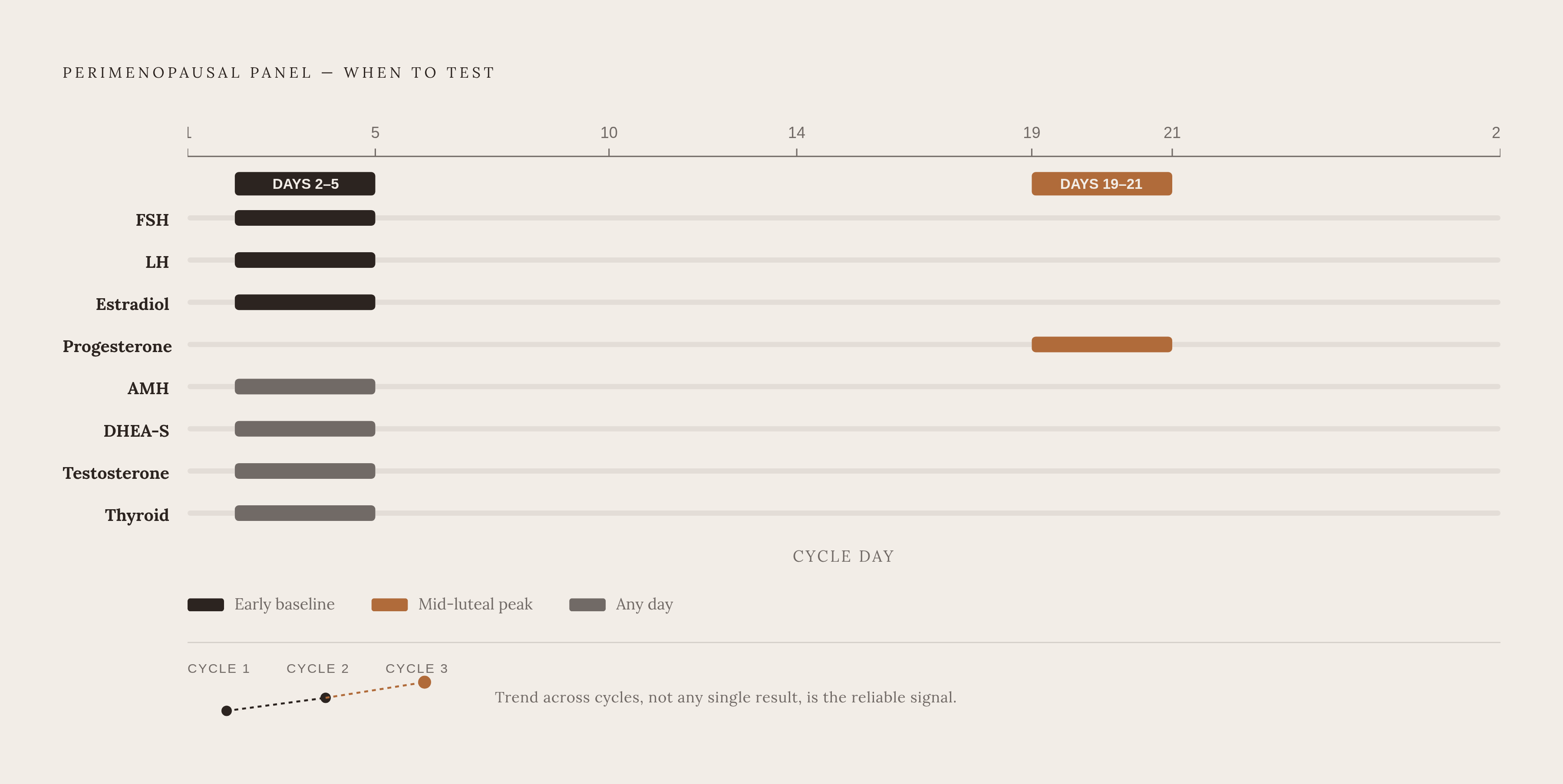
A fuller panel covers estradiol, progesterone, FSH, LH, DHEA-S, AMH, thyroid hormones, and testosterone, and each one fills in a different piece of the picture. FSH gets tested early in the cycle, days 2 through 5, to establish a baseline, and an elevated baseline can point to declining ovarian function, though it needs tracking across multiple cycles rather than a one-time reading treated as a verdict. Progesterone gets tested mid-luteal phase, days 19 through 21. If it is low right when it should be peaking, that is a strong signal ovulation was weak or absent that cycle, a pattern that builds a clearer perimenopausal picture the more times it repeats. Thyroid function has to be ruled out separately, since thyroid dysfunction can worsen or closely mimic the same cognitive and mood symptoms. Testosterone matters too, even at the lower levels typical in women, given its role in mood, motivation, and energy.
The strongest argument for testing is the trend line, not any single number on it: FSH climbing over successive cycles, progesterone consistently failing to peak mid-luteal, estradiol swinging instead of declining in a smooth, predictable curve. That longitudinal pattern says more than any isolated result ever could, and treating one test result as the final word is the single most common way this gets misread. If a clinician orders one panel and calls it settled, the workup was not thorough enough to catch what perimenopause actually looks like on paper.
Telling perimenopause brain fog from clinical depression when they overlap
These two conditions can and do coexist, and pretending otherwise is its own kind of mistake. A 2024 meta-analysis found perimenopausal women carry a 40% higher risk of depression compared to premenopausal women. Some portion of that risk is hormonally driven mood disruption, and another portion is a genuine depressive episode that needs its own treatment path regardless of what triggered it. Untangling which is which, or recognizing that both are present at once, is the actual clinical task. Picking one label and stopping there falls short of it.
A few features tend to point toward the hormonal pattern over a primary mood disorder. Cognitive symptoms, the word-finding trouble, the concentration lapses, the shaky working memory, often appear alongside mood changes or even ahead of them, rather than trailing behind as a secondary effect. Symptoms tend to rise and fall with the hormonal cycle instead of sitting at a flat, constant baseline. Exhaustion resists rest in a way situational burnout usually does not, since burnout tends to ease somewhat with a real break while this kind of fatigue holds steady regardless. Anxiety in this context carries a distinctly physical signature: palpitations, sudden heat, and a racing pulse that occurs independent of any specific worry.
None of this argues for throwing out a depression or anxiety diagnosis when one is warranted. But how does this change what actually happens in the exam room? It argues for asking a second question before settling on the first answer: is this mood, is this hormones, or is it both at once. Asked early enough, paired with longitudinal testing rather than a single lab snapshot, that question is what closes the three-year gap instead of extending it.