Blood Sugar Volatility and Concentration Problems
Estrogen swings destabilize blood sugar and fog your brain during perimenopause.

Blood sugar volatility during perimenopause is not a failure of discipline or a diet gone wrong. It is a direct, mechanical consequence of estrogen and progesterone swinging out of their usual coordination, and that swing disrupts the glucose-insulin axis in ways that produce afternoon crashes, carb cravings, midsection weight gain, and a specific kind of fog that makes concentration genuinely harder. The vast majority of women report symptoms during this transition, and cognitive complaints, the difficulty holding a thought or finishing a task, belong on that list right alongside hot flashes and mood swings. The instinct is to blame stress, willpower, aging, or depression. Each of those is plausible on its own. This piece sets out to trace the actual biology that produces these symptoms.
How estrogen and progesterone regulate blood sugar under normal conditions
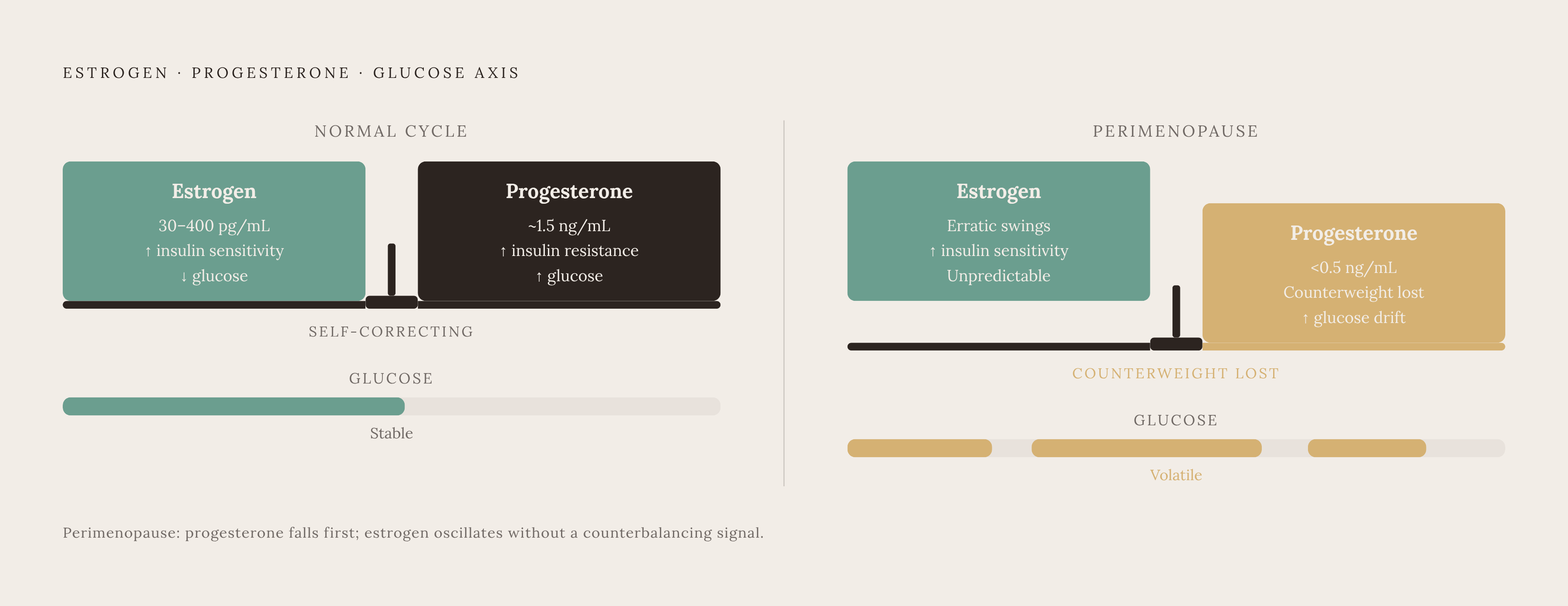
Estrogen is, among other things, a metabolic hormone. It improves insulin sensitivity, helps cells take up glucose more efficiently, and generally keeps insulin resistance low. This is why premenopausal women, measured against men of the same age, tend to show meaningfully better insulin sensitivity. It is not a minor footnote in reproductive biology; it is a systemic effect that touches nearly every tissue that responds to insulin.
Progesterone works the other direction. When it rises, particularly during the luteal phase of the cycle, it can push insulin resistance up and raise blood glucose somewhat. Progesterone works the other direction: when it rises, particularly during the luteal phase of the cycle, it can push insulin resistance up and raise blood glucose somewhat, and this is a counterweight, and a necessary one, because a system tuned only toward insulin sensitivity would leave blood sugar too unstable in its own right. It is a counterweight, and a necessary one, because a system tuned only toward insulin sensitivity would leave blood sugar too unstable in its own right.
Consider the numbers. Estradiol in premenopausal women ranges anywhere from 30 to 400 pg/mL depending on cycle phase, a range wide enough to reflect just how much physiological work this hormone is doing across a single month. Progesterone, meanwhile, is around 1.5 ng/mL as a general premenopausal marker. Across a normal cycle, these two hormones move in a choreographed oscillation, estrogen up, progesterone up, both retreating, repeat. The glucose-insulin axis rides along with them, self-correcting, rarely calling attention to itself. That quiet coordination is precisely what perimenopause breaks.
What happens to that system during perimenopause
Here is the detail most explanations skip: estrogen does not decline steadily in perimenopause the way people assume. It swings. Levels can look entirely normal on a Tuesday, drop low by Friday, and spike high again the following Sunday. That volatility is the defining feature of the transition.
Progesterone usually goes first, and it goes faster. Many perimenopausal cycles stop ovulating even while periods keep occurring on schedule, which is deceptive on its face. No ovulation means no corpus luteum, and no corpus luteum means no progesterone surge. So the ratio between the two hormones tilts, sometimes sharply, toward estrogen dominance in a given cycle.
What does that tilt actually do to blood sugar? When estrogen spikes, insulin sensitivity spikes with it, and that can tip into outright hypoglycemia, the shaky, foggy, must-eat-something-now feeling. When progesterone-dominant windows occur instead, insulin resistance climbs and glucose runs high. Neither state holds still long enough to become the new normal. The oscillation between the two is what produces the crashes, the cravings, the sense that blood sugar has become unpredictable in a way it never used to be. Symptom clustering tends to occur in the late luteal phase specifically, when progesterone is already low and ovulation may not have happened. That is often the first clue, before anyone thinks to call it hormonal, that the pattern is cyclical rather than random.
The cortisol and sleep loop that makes everything worse
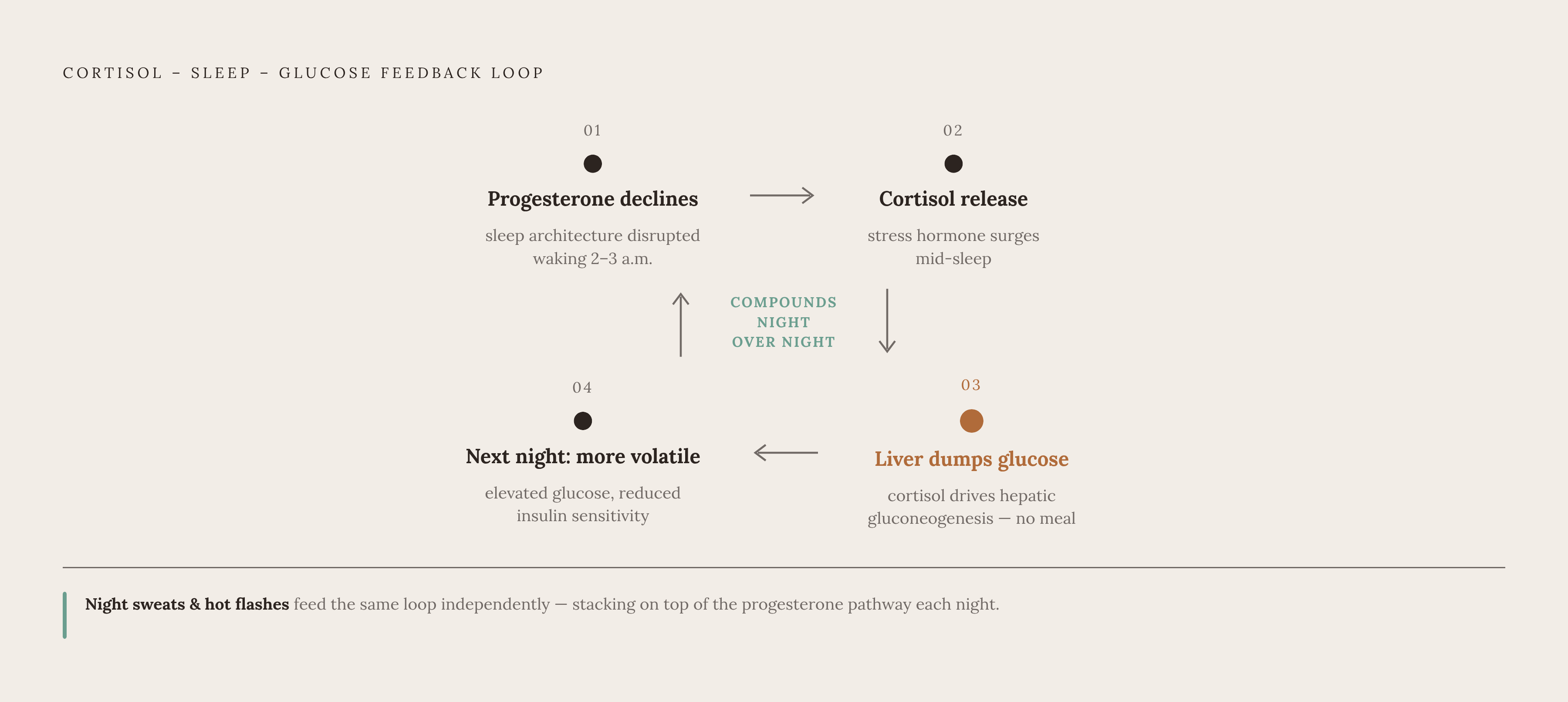
But how does this affect sleep, and why does sleep matter so much here? Declining progesterone disrupts sleep architecture directly, and one of the more recognizable signs is waking consistently around 2 or 3 in the morning for no obvious reason. That disruption triggers a cortisol release. Cortisol drives gluconeogenesis in the liver, so the liver dumps glucose into the bloodstream even without a meal involved. Blood glucose rises, insulin sensitivity takes a hit the next day, and the following night tends to be more volatile than the last. It compounds.
Night sweats add their own damage to that same loop, independent of the progesterone mechanism. A hot flash that interrupts sleep does the same downstream work: it tanks insulin sensitivity and elevates cortisol the next morning, stacking on top of whatever the progesterone drop is already doing.
Women often describe this as getting worse across consecutive rough nights rather than as a series of isolated bad ones, which fits the mechanism. After menopause is reached, progesterone falls below 0.5 ng/mL. That is a measurable, substantial loss of a hormone that had been quietly supporting sleep architecture for decades, and its absence is not subtle once it is gone.
The brain's specific vulnerability to glucose volatility during this transition
The brain runs on glucose more than any other organ in the body, and even mild instability in that supply affects function directly: trouble concentrating, slower processing, short-term memory lapses that feel uncharacteristic. This is where the metabolic story and the cognitive story stop being two separate complaints.
Estrogen has its own direct neurological job, separate from glucose regulation. Preclinical work shows it enhances memory and learning and supports dendritic spine growth in the hippocampus and medial prefrontal cortex, both regions central to attention and recall. Estriol in particular binds preferentially to estrogen receptor beta, ERβ, which appears to drive a neuroprotective effect in brain tissue.
So the brain absorbs two hits at once during this transition: it is losing a hormone that actively protects and builds neural architecture, at the exact moment its primary fuel source becomes unreliable. These are not parallel problems that happen to coincide. They compound each other. Emerging clinical work exploring combined estriol and progesterone treatment has pointed toward improvements in cognitive symptoms, though the evidence remains early and should not be read as a verdict. What it does suggest is a connection between hormone stabilization and measurable cognitive relief, which is exactly the link this piece has been building toward.
The limits of a single hormone test or a single glucose reading in capturing what is happening
If estrogen and FSH can rise, fall, and contradict each other within the same few weeks, then a single blood draw showing a normal result does not rule much out. It just captures one moment in a system that is, by definition, unstable during this window. A woman could test on a high-estrogen day and walk away reassured, when the low day three days later is the one actually driving her symptoms.
The same logic holds for glucose. What mattered was checking whether the same pattern kept recurring. The pattern's recurrence, its clustering in a particular part of the cycle, and its growth in intensity over the past several months are what matter. None of that is visible in a single fasting glucose number.
FSH deserves a specific caveat here. A persistently elevated FSH generally does point toward the hormonal shifts around menopause. But "persistently" is the operative word, because perimenopausal swings can produce a normal reading one week and a high one the next. FSH functions better as a trend marker than as a yes-or-no switch.
There is also a ratio problem baked into how lab ranges get built. Reference ranges reflect broad population averages, not individual balance. A woman can have progesterone that is technically within range, just at the low end, paired with estrogen running high, and feel the full weight of the imbalance while both numbers individually look fine on paper. The ratio between the two hormones carries as much information as either number alone, arguably more.
What a useful testing picture includes, and when to test
FSH earns its keep most clearly in women who already have symptoms, or in those where premature ovarian insufficiency is a concern, and it functions better as a trend marker to track over time than as a yes-or-no diagnostic switch.
Estradiol testing benefits from timing within the cycle rather than a single draw. Testing at multiple points across the cycle captures the arc of perimenopausal fluctuation in a way one number cannot. Progesterone should be tested mid-luteal, when it should be at its peak; a declining or absent peak is a fairly direct sign the cycle was anovulatory. AMH declines as ovarian reserve falls, sometimes before FSH ever moves, but it is not precise enough to diagnose perimenopause on its own or to predict its timing with any real accuracy, and it should not be leaned on that way in routine care.
Metabolic markers belong in the same panel as part of the same conversation. Fasting glucose and fasting insulin together capture baseline insulin resistance in a way that glucose alone misses. A1C adds a trend view over roughly three months, useful but not sufficient by itself. Lipids matter too, since metabolic risk shifts during this transition in ways that go beyond glucose.
Ruling out the conditions that mimic this presentation almost exactly is equally important. TSH, with free T4 if needed, rules out thyroid dysfunction, which can produce nearly identical fatigue and cognitive symptoms. Ferritin and B12 catch anemia and deficiency states that overlap heavily with perimenopausal complaints. Vitamin D and inflammation markers round out a picture that, taken together, actually means something.
None of this is a one-time errand. Because levels shift meaningfully month to month during this transition, repeat testing every few months makes more sense than a single panel treated as final.
Tracking patterns over time instead of collecting snapshots
That raises an obvious question: if one test cannot capture the pattern, what does? Does that same blood sugar crash keep recurring? Does it get worse specifically in the late luteal phase? Does it track with how well someone slept the night before, or the two nights before? Has it quietly worsened over the last six months compared to a year ago? None of these questions has an answer inside a single lab result.
Continuous glucose monitors offer one practical way to close that gap. They show, in real time, how a given meal, a workout, a stressful afternoon, or a bad night of sleep actually moves blood sugar over hours and days, rather than at one arbitrary moment. That kind of resolution is especially important here because perimenopausal glucose patterns move on a cyclical rhythm rather than a flat baseline.
Longitudinal hormone tracking does similar work from the other direction. It shows whether the volatility is trending toward stabilization or getting worse, which cycle phase produces the roughest metabolic symptoms for a given woman specifically, and gives a clinician something to actually review across visits instead of one isolated result that may or may not mean anything.
Symptom journaling sounds almost too simple next to a continuous monitoring device, but it fills a real gap. Logging meals, sleep quality, cycle phase, and symptom severity together, day after day, builds a dataset that reveals patterns neither the patient nor the clinician would likely spot from memory alone.
What women can do now while they pursue answers
None of this is a substitute for testing, and none of it replaces a clinician actually reviewing the results over time. But the mechanisms described above respond to some fairly direct interventions in the meantime, and there is no reason to wait on a lab result before starting them.
On the food side: pairing carbohydrates with protein and healthy fat at every meal slows glucose absorption and flattens the spike-and-crash curve considerably. A rough target of 20 to 30 grams of protein per meal gives that pairing something to work with. Fiber matters just as much, aiming for at least 25 grams a day from vegetables, legumes, and whole grains, since fiber directly blunts the post-meal glucose spike. Avoid large meals within three or four hours of bedtime too, since they feed straight into the nocturnal cortisol-glucose loop described earlier.
Exercise carries real weight here, and not just generically. Strength training two to three times a week builds muscle tissue, which is the primary site where the body actually disposes of glucose, so more muscle mass translates fairly directly into better insulin sensitivity. Timing adds another layer: a short walk after a meal measurably blunts the glucose response to that meal, which is a small habit with an outsized return.
Sleep deserves to be treated as metabolic management, not comfort. Protecting sleep quality interrupts the cortisol-glucose loop at its source, which makes it a direct lever rather than a peripheral wellness suggestion. Addressing night sweats specifically, through a cooler room or breathable bedding, reduces the autonomic disruption that otherwise compounds the whole cycle night after night.
Taken together, these steps will not resolve the underlying hormonal shift. That is not the claim. What they do is soften the volatility while testing, tracking, and clinical review do the slower work of building an actual picture, one that a single appointment or a single number was never going to provide.
Sources
- Menopause and blood sugar explained | Ultrahuman Blog
- Why Blood Sugar Feels Different During Perimenopause
- Perimenopause and glucose sensitivity: what to watch for • Vively
- signoshealth.com
- progevita.com
- Byram Healthcare
- Progesterone increases blood glucose via hepatic progesterone receptor membrane component 1 under limited or impaired action of insulin | Scientific Reports
- bywinona.com