Insulin Resistance Development in Perimenopause
Estrogen drives glucose control, and its decline explains perimenopausal insulin resistance.

Insulin resistance in perimenopause is not a failure of discipline, and it is not some inevitable side effect of aging that women are supposed to quietly manage with kale and willpower. It is a hormonally driven process with a traceable mechanism, one that starts with estrogen's outsized role in glucose regulation and unfolds in a fairly predictable sequence as levels shift and eventually fall. This piece walks through that mechanism step by step: what estrogen does when it's present, what breaks when it declines, how fat and sleep and lab testing all feed into the same problem, and what the hormone therapy data actually shows about reversing it.
Perimenopause is a transition that can run a decade or longer before menopause actually arrives, and most women enter it somewhere between ages 45 and 47, with the average age of menopause in one country landing... It's a transition that can run a decade or longer before menopause actually arrives, and most women enter it somewhere between ages 45 and 47, with the average age of menopause in one country landing around 52. The hormonal choreography during that window is easy to misread. Progesterone drops first, and it drops steadily. Estrogen, by contrast, doesn't decline in a straight line at all: it fluctuates, sometimes surging well above premenopausal levels before it ever starts its longer descent. That's why a lot of women spend early perimenopause dealing with symptoms of estrogen excess, not deficiency, and why the metabolic disruption described in this piece often starts during the fluctuation phase, long before estrogen actually bottoms out. The symptoms that appear along the way, caused by estradiol decline and visible in daily patterns, include the sudden hunger, the 3 p.m. energy crash, the brain fog, the stubborn belly fat, tend to get chalked up to stress or "just getting older." They're not. They map onto specific, describable biology, and that's what the rest of this piece unpacks.
What estrogen does for glucose regulation when it is present
Estrogen is an active insulin sensitizer, doing that job through a few specific, well-characterized pathways. It's an active insulin sensitizer, and it does that job through a few specific, well-characterized pathways.
One of the more important is its effect on PI3K/Akt signaling inside skeletal muscle. Estrogen activates this pathway, and that activation pushes GLUT4 transporter proteins to the surface of muscle cells. GLUT4 is the actual gatekeeper that pulls glucose out of the bloodstream and into the cell after a meal. No GLUT4 at the surface, no glucose uptake, no matter how much insulin is circulating. Estrogen also works on the liver side of the equation: it suppresses hepatic gluconeogenesis, the liver's baseline habit of manufacturing and releasing glucose between meals. That suppression is part of why fasting glucose stays steady in premenopausal women even during long stretches without food.
Estrogen acts through two nuclear receptors, ESR1 and ESR2, and the two don't point in the same direction. Estrogen acts through two nuclear receptors, ESR1 and ESR2, and the two don't point in the same direction. ESR1-mediated signaling supports healthy glucose regulation. ESR2-mediated signaling works against it. So the ratio of ESR1 to ESR2 activity, not just the total amount of circulating estrogen, matters for how glucose gets handled. That ratio becomes a real plot point later in this piece, when the hormone therapy research raises the question of timing.
How estradiol decline triggers insulin resistance through multiple simultaneous pathways
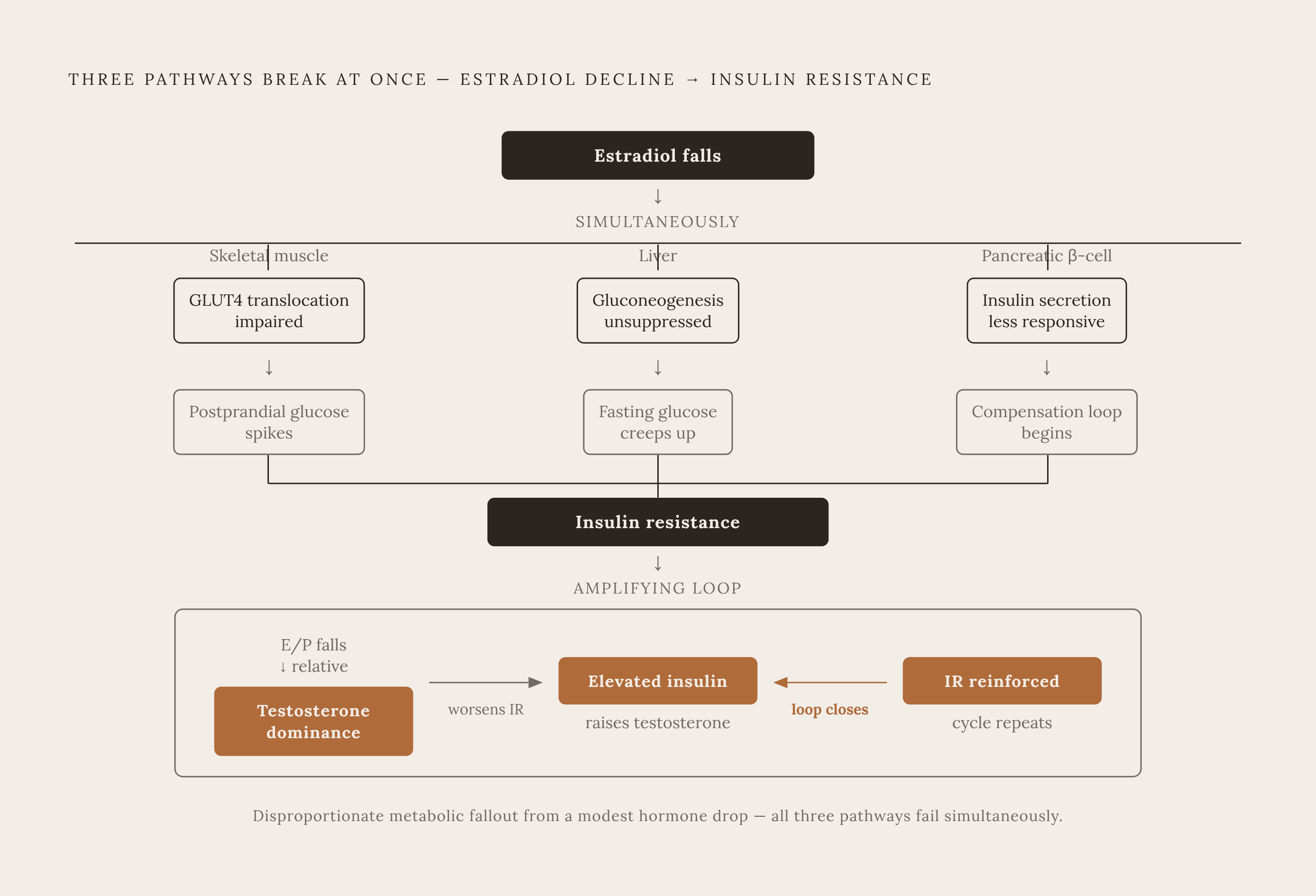
When estradiol falls, insulin resistance doesn't develop through one broken pathway. It develops through several breaking at once. That is why the metabolic fallout looks disproportionate to the amount of hormone actually lost.
Walk through what's happening simultaneously. GLUT4 translocation gets impaired, so muscle cells pull in less glucose after meals, and postprandial glucose spikes get worse. At the same time, the liver loses the suppression signal that used to keep it quiet between meals, so it starts releasing more glucose on its own, and fasting glucose creeps upward. Pancreatic beta-cell function starts deteriorating too, meaning insulin secretion becomes less responsive and less well-timed to actual glucose load. Longitudinal cohort research tracking women through the perimenopausal transition has documented a real, steepening decline in insulin-stimulated glucose disposal over this period. So this isn't just "getting older" or "gaining weight" wearing a hormonal disguise.
Progesterone plays its own supporting role in this collapse. It normally helps stabilize the HPA axis, the body's central stress-response system, and as progesterone drops, HPA regulation gets shakier. That instability worsens blood sugar management on its own and tends to amplify cravings and appetite swings, which makes the whole picture harder to manage through diet alone.
Then there's testosterone, and this is where the cycle starts feeding itself. As estrogen and progesterone both decline, testosterone doesn't necessarily drop at the same rate, so the relative hormonal picture shifts toward testosterone dominance. That shift independently worsens insulin resistance and promotes weight gain. But elevated insulin can turn around and raise testosterone further, and the imbalance reinforces itself rather than settling into some new equilibrium. One mechanism triggers the next, which loops back and amplifies the first. That's the disproportionate part.
How body composition changes during perimenopause feed the insulin resistance cycle
Before perimenopause, fat tends to settle in gluteofemoral depots, the hips and thighs. That gynoid fat behaves very differently, metabolically, from fat stored elsewhere.
During perimenopause, that storage pattern shifts, often fast. Visceral adipose tissue, the fat packed around abdominal organs, expands, and it can expand meaningfully even in women who haven't gained much weight overall on the scale. Meanwhile gluteofemoral subcutaneous fat shrinks. The redistribution, not necessarily the total pounds, is the metabolically relevant event.
Visceral fat behaves nothing like subcutaneous fat, and not in a good way. It has higher lipolytic activity: it breaks down and releases free fatty acids into the portal circulation at a higher rate, which drives insulin resistance directly in the liver. It also secretes pro-inflammatory signaling molecules, including a couple of well-known inflammatory markers, generating a low-grade systemic inflammation that further degrades insulin signaling throughout the body. On top of that, visceral fat also disrupts the hormonal signals that normally regulate appetite, and its expansion is associated with an unfavorable shift in triglycerides and related metabolic markers.
The pancreas, watching all of this unfold, does what it's built to do: it compensates. As hepatic insulin resistance deepens, the pancreas pumps out more insulin to try to force glucose into cells anyway. But high circulating insulin promotes further fat accumulation rather than mobilization. That new fat drives more inflammation and more insulin resistance, which demands even more insulin. It's a closed loop, and it tightens on its own unless something interrupts it.
Why sleep disruption worsens insulin resistance during perimenopause
Sleep trouble in perimenopause gets treated as a lifestyle nuisance, something to fix with a better mattress or a wind-down routine. But it's driven by the same hormonal shifts running through everything else in this piece. Hot flushes interrupt sleep architecture directly. Low progesterone strips away the mild sedating effect it normally provides at night. And a less stable HPA axis raises baseline arousal, making it harder to fall asleep or stay asleep.
Poor sleep then does its own independent damage. It raises cortisol, and elevated cortisol both inhibits insulin's action and stimulates the liver to produce more glucose, stacking a third glucose-raising force on top of the two already running from estrogen loss. Waking at 3 a.m. Hunger, or hitting a wall of carb cravings mid-afternoon, is usually a result of overnight blood glucose swinging around under the influence of elevated cortisol, not a willpower problem. It's often overnight blood glucose swinging around under the influence of elevated cortisol.
Sleep deprivation also independently impairs glucose tolerance, adding to the metabolic burden already created by hormonal decline. In effect, poor sleep and hormonal decline push glucose regulation in the same direction, and the two processes compound each other. The two processes point in the same direction and compound each other.
Why standard lab tests miss insulin resistance until it is well advanced
Most metabolic screening leans on two numbers: fasting glucose and HbA1c. Both are late-stage markers, and that's the core problem with relying on them alone during perimenopause.
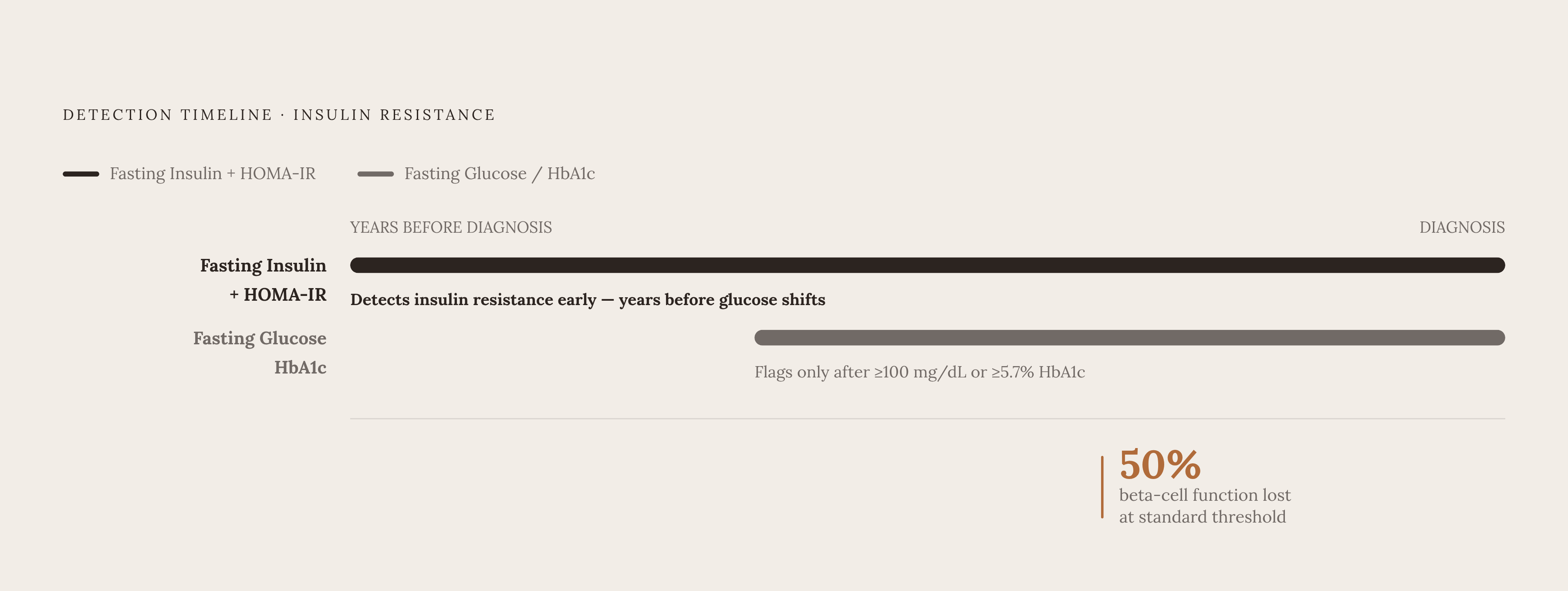
Fasting glucose tends to stay inside the normal reference range well into late perimenopause, because the mechanism described earlier hits postprandial glucose (the spike after meals) long before it touches fasting glucose. A test that only samples the fasting state simply doesn't see the problem yet. By the time fasting glucose crosses 100 mg/dL, or HbA1c crosses 5.7%, as much as half of beta-cell function may already be lost, meaning the pancreas has been masking a spreading insulin resistance long before these markers moved. At that point, as much as half of beta-cell function may already be gone.
Fasting insulin and the HOMA-IR calculation (which uses fasting insulin and fasting glucose together to estimate insulin resistance) can flag the problem years before conventional markers move out of range. That gap is arguably the single most useful fact in this entire piece. It means the standard annual physical, built around fasting glucose and HbA1c, is structurally unable to catch this early, and women relying on "normal bloodwork" as reassurance may be looking at the wrong numbers.
The hormone therapy evidence on reversing the estrogen-insulin relationship
So does correcting the hormone actually correct the downstream metabolic damage? The evidence says yes, and it's not a thin evidence base. A meta-analysis of 17 randomized controlled trials, covered in a press release from The Menopause Society, pooled data from more than 29,000 participants, 15,350 of whom were randomized to hormone therapy and 13,937 to placebo. That's a large enough dataset to take seriously.
The finding: hormone therapy significantly reduced insulin resistance in healthy postmenopausal women who didn't already have diabetes, hypertension, or cardiovascular disease going in. That's an important qualifier, since it isolates the estrogen-insulin relationship from the noise of pre-existing metabolic disease. The mechanism lines up with the biology described earlier in this piece, and it holds in both human and animal studies: estradiol replacement works against the insulin resistance mechanisms described earlier in this piece, including in the skeletal muscle tissue that plays a central role in insulin-stimulated glucose disposal.
The ESR1:ESR2 ratio mentioned earlier turns out to matter here too. Research suggests that changes in glucose handling over the years since menopause may track a declining ESR1:ESR2 ratio over time, which raises a real question about timing: does starting estrogen therapy earlier in the transition produce a better metabolic outcome than starting later? The data lean toward yes, though timing deserves more scrutiny than a blanket answer. It's a reasonable thing to raise with a physician rather than something to self-diagnose from a research summary.
Targeted lifestyle strategies that address the hormonal mechanisms, not just calories
Generic advice, eat less, move more, fails perimenopausal women because it ignores everything laid out above. The useful version of lifestyle intervention here isn't generic at all: it targets the specific mechanisms already broken.
Strength training is at the top of that list, and not as a vague wellness recommendation. Declining estrogen accelerates muscle loss, and skeletal muscle is a primary site of insulin-stimulated glucose disposal, so losing it removes capacity from the exact system that's already struggling. Resistance training preserves that lean mass and supports glucose uptake in muscle cells, which addresses the very first mechanism described in this piece. None of this requires a gym membership or specialized equipment; bodyweight resistance work applies the same stimulus.
Timing matters for aerobic exercise too. Insulin sensitivity can stay elevated for up to 16 hours after a session of exercise, so a walk after dinner or a workout earlier in the day isn't just "movement," it's a window during which glucose gets handled more efficiently. Pairing that window with actual glucose-sensitive moments, meals, evening snacking, has practical value beyond generic activity totals.
Protein intake rounds this out. Adequate protein supports the muscle preservation that counters the sarcopenia driving metabolic rate downward, increases satiety (which matters given the appetite dysregulation already discussed), and stabilizes the glucose spike that follows a meal. None of these three strategies work by cutting calories. They work by targeting the actual mechanism: muscle, timing, and the hormonal signal that regulates hunger. That's the throughline of this entire piece. The biology is specific, it's traceable, and it responds to specific intervention, not to vague effort.
Sources
- Metabolic syndrome, insulin resistance and menopause: the changes in body structure and the therapeutic approach
- Balancing Hormones and Blood Sugar: A Dietitian’s Guide to Perimenopause and Insulin Resistance - caraschragernutrition.com
- New Meta-Analysis Shows That Hormone Therapy Can Significantly Reduce Insulin Resistance | The Menopause Society
- Estrogen Improves Insulin Sensitivity and Suppresses Gluconeogenesis via the Transcription Factor Foxo1 | Diabetes | American Diabetes Association
- Estrogen and Glycemic Homeostasis: The Fundamental Role of Nuclear Estrogen Receptors ESR1/ESR2 in Glucose Transporter GLUT4 Regulation
- The Role of Estrogen in Insulin Resistance - The American Journal of Pathology
- ncbi.nlm.nih.gov
- sleepfoundation.org